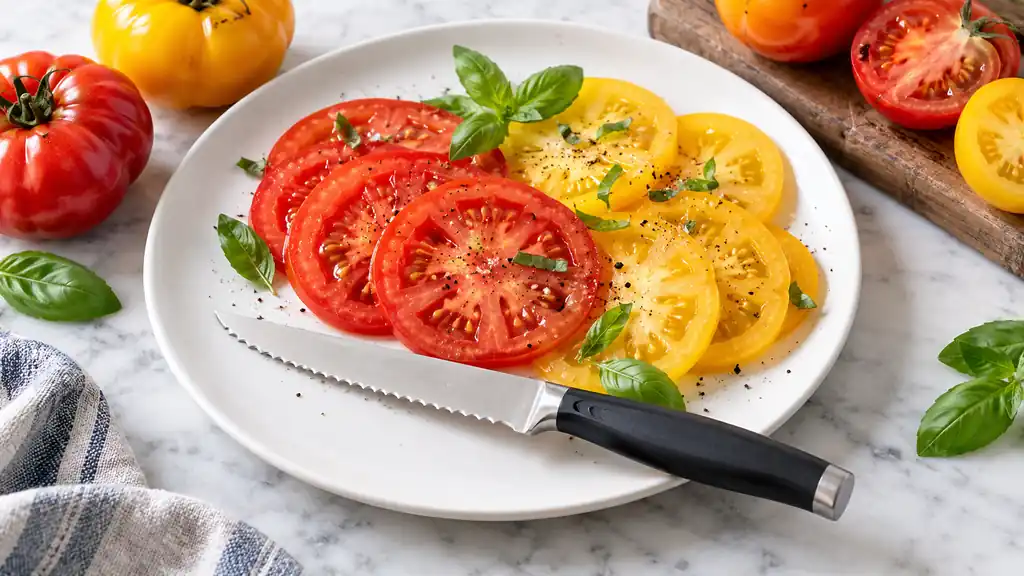
A ripe tomato can expose a weak knife in seconds. The skin catches, the flesh collapses, and the cutting board ends up dotted with juice instead of neat slices ready for a BLT, burger, salad, or sandwich. The best knife for tomatoes usually has a serrated edge that can start through taut skin without demanding heavy downward pressure. A dedicated tomato knife also gives you better control than a broad chef’s knife for small, delicate produce.
Shoppers often focus on the word “sharp” and overlook the details that matter more for this task. Serration pattern, blade length, handle grip, cleaning instructions, and the difference between a table knife and a heavier kitchen knife all affect day-to-day use. A 4.3-inch blade may feel nimble beside a small cutting board, while a 5-inch model can offer more reach for large tomatoes. Steel descriptions also vary widely, so a named alloy such as T420, X50CrMoV15, or 10Cr15CoMoV provides more useful information than a vague claim about premium metal.
The nine knives below cover dedicated tomato slicers, compact table-style options, and sturdier kitchen designs. Priorities differ: one cook may want a dishwasher-friendly knife for quick breakfasts, while another may prefer a hand-wash-only model with a more substantial handle and construction. The Victorinox Swiss Classic 4.3-inch Tomato and Table Knife is the strongest overall match because its compact serrated blade, textured handle, and stated Swiss stainless-steel construction suit everyday tomato preparation without adding unnecessary bulk.
Quick Answer
- Best Overall: The Victorinox Swiss Classic 4.3-inch Tomato and Table Knife combines a compact blade, serrated edge, non-slip handle, and versatile table-use format.
- Best Premium Design: The Wüsthof Classic 5-inch Tomato Knife offers a finely serrated edge, forked tip, full-tang construction, and a documented 58 HRC hardness rating.
- Best Dedicated Slicer: The RADA Cutlery W226 uses a 5-inch dual-serrated blade, hollow-ground construction, and T420 high-carbon stainless steel for tomato-focused preparation.
Best Knife For Tomatoes Comparison Table
| Product | Best For | Blade Length | Edge And Steel |
|---|---|---|---|
| Victorinox Swiss Classic Tomato and Table Knife | Everyday kitchen and table use | 4.3 inches | Serrated stainless steel |
| Wüsthof Classic Tomato Knife | Premium construction | 5 inches | Fine serrations, high-carbon stainless steel |
| RADA Cutlery W226 Tomato Slicer | Dedicated tomato slicing | 5 inches | Dual serrations, T420 stainless steel |
| Mercer Culinary Renaissance Tomato Knife | Traditional kitchen-handle design | 5 inches | Serrated high-carbon German cutlery steel |
| Haokithcun Serrated Tomato Knife | Versatile soft-food prep | 5 inches | Micro-serrated X50CrMoV15 steel |
| Omesata Tomato Knife | Textured-grip tomato slicing | Not stated | Serrated high-carbon stainless steel |
| Yunletwood Tomato Knife 2-Pack | Keeping a spare available | Not stated | Serrated high-carbon stainless steel |
| PAUDIN Tomato Knife | Controlled five-inch slicing | 5 inches | Double serrations, 5Cr15MoV steel |
| HOSHANHO Japanese Tomato Knife | Specified steel and edge angle | 5 inches | Serrated 10Cr15CoMoV steel |
The detailed reviews show how these knives differ in edge design, handle materials, care requirements, and intended use.
1. Victorinox Swiss Classic 4.3 In Tomato and Table Knife – Best Overall

A short tomato knife is often easier to live with than a larger slicer. The Victorinox Swiss Classic uses a 4.3-inch serrated stainless-steel blade, a practical size for slicing tomatoes directly on a small board or carrying the knife from the kitchen to the table. Its compact format should appeal to cooks who dislike a long blade getting in the way during quick jobs such as halving cherry tomatoes or preparing sandwich toppings.
The textured, non-slip handle is another useful detail. The listing describes a lightweight Swiss stainless-steel blade with a conical ground and ice-tempered construction, although it does not provide a specific steel designation. That means the available information supports a practical stainless-steel design, while it does not support a precise claim about alloy performance. The knife is also positioned for table use, so it can serve at dinner instead of occupying space as a single-purpose tool.
Pros
- Compact 4.3-inch blade suits small cutting boards and table use.
- Serrated edge is appropriate for soft-skinned fruits and vegetables.
- Textured handle is described as non-slip, including when wet.
- Lightweight stainless-steel construction should be easy to handle for short tasks.
- Available information identifies Swiss manufacture and a lifetime guarantee against material and workmanship defects.
Cons
- Shorter blade provides less reach for very large tomatoes or wider produce.
- The available information does not identify a specific stainless-steel alloy.
This is the most balanced choice for a household that wants one tomato knife for both food preparation and the dinner table. It is less suitable for someone seeking a substantial full-size kitchen knife or a specialist model with a documented alloy and edge angle. For everyday slicing, the small footprint and grippy handle are more useful than extra heft.
To buy this product, click here.
2. Wüsthof Classic 5-Inch Tomato Knife – Best Premium Design

The Wüsthof Classic takes a more substantial approach to tomato slicing. Its 5-inch blade has fine serrations and a forked tip, allowing the knife to slice through skins and lift or serve pieces once they are cut. That forked tip is a meaningful distinction for a table setting or a platter of tomatoes, where the knife may need to do a little more than move straight down through the fruit.
The construction details are unusually specific in the supplied information. The knife is forged from high-carbon stainless steel, tempered to 58 HRC, and built with a full tang, triple rivets, and a synthetic polypropylene handle. These features describe a traditional, durable kitchen-knife format, although the HRC figure alone cannot establish how long the edge will last in a particular home. Wüsthof recommends hand washing, so this is a better fit for owners willing to dry and store a dedicated knife carefully.
Pros
- Fine serrations are intended for tomatoes, cheese, and fruit.
- Forked tip adds serving utility after slicing.
- Full-tang, triple-riveted construction is clearly documented.
- High-carbon stainless steel and a stated 58 HRC hardness provide more technical detail than many listings.
- Polypropylene handle is described as resistant to fading, heat, and impact.
Cons
- Hand washing is recommended, adding care compared with dishwasher-suitable options.
- Its more substantial construction may be unnecessary for occasional table use.
This model suits a cook building a carefully maintained knife collection and wanting a dedicated tomato blade with serving features. It may be excessive for someone who simply needs a spare knife beside the toaster. The premium appeal comes from documented construction and the forked tip, rather than from a claim that the blade is universally superior to every serrated alternative.
To buy this product, click here.
3. RADA Cutlery Tomato Slicer Knife W226 – Best Dedicated Slicer

RADA’s W226 is aimed squarely at the familiar tomato problem: a firm outer skin wrapped around soft, juicy flesh. Its 5-inch dual-serrated blade is intended for thick or thin slices, and the hollow-ground T420 high-carbon stainless steel construction gives the listing a defined material description rather than a broad “premium steel” label. For a cook who regularly prepares BLTs, burgers, vegetable trays, or side dishes, that focused design makes sense.
The black resin handle is dishwasher-safe according to the supplied product information. That can matter after a large lunch preparation, when a knife covered in tomato juice is more likely to go straight into the cleanup routine. Dishwasher compatibility does not remove the need for sensible care, but it gives this model a different ownership profile from hand-wash-only premium knives.
Pros
- Dual-serrated edge is intended for clean tomato slices.
- Five-inch blade provides useful reach without becoming a long slicer.
- T420 high-carbon stainless steel is specifically identified.
- Hollow-ground construction is listed as part of the blade design.
- Dishwasher-safe black resin handle suits busy kitchen cleanup.
Cons
- The specialized tomato-slicer format offers less table versatility than a tomato-and-table knife.
- The available information does not provide a specific blade angle or weight.
The W226 is a strong choice for regular sandwich, burger, and salad preparation. Its dedicated serration pattern matters more here than decorative styling, while the dishwasher-safe handle simplifies ownership. Choose another style if you want a forked tip, a compact table knife, or a multipurpose blade for tasks beyond soft produce.
To buy this product, click here.
4. Mercer Culinary M23610 Renaissance 5-Inch Tomato Knife – Best Traditional Handle

Mercer gives this tomato knife a conventional kitchen-knife profile rather than a lightweight table-knife presentation. The Renaissance model has a 5-inch serrated blade and a triple-riveted handle with a rounded spine. Those construction details are relevant for anyone who wants a tomato knife that looks and handles more like part of a standard knife collection than a utensil reserved for the dining table.
The blade is described as precision-forged from high-carbon German cutlery steel. That identifies the material category and construction method, but it does not establish a precise alloy or guarantee a particular edge lifespan. Mercer specifically recommends hand washing with mild soap, thorough rinsing, and complete drying. It also advises against long submersion, so this knife belongs with owners who are comfortable giving it a quick wash rather than leaving it in a sink.
Pros
- Five-inch serrated blade is sized for tomatoes and other soft produce.
- Precision-forged construction is clearly stated.
- High-carbon German cutlery steel is identified in the product information.
- Triple rivets and a rounded spine give the handle a traditional kitchen-knife format.
- Manufacturer care guidance is specific and easy to follow.
Cons
- Hand washing and prompt drying are required for the recommended care routine.
- The available listing does not specify the exact steel grade or blade angle.
This Mercer is a sensible fit for someone who values a familiar riveted handle and wants a dedicated tomato knife that sits comfortably beside other kitchen knives. It is less appealing for a household that prioritizes dishwasher cleaning or wants the smallest possible table knife. The trade-off is straightforward: more traditional construction in exchange for more deliberate maintenance.
To buy this product, click here.
5. Haokithcun 5-Inch Serrated Tomato Knife – Best for Versatile Soft-Food Prep
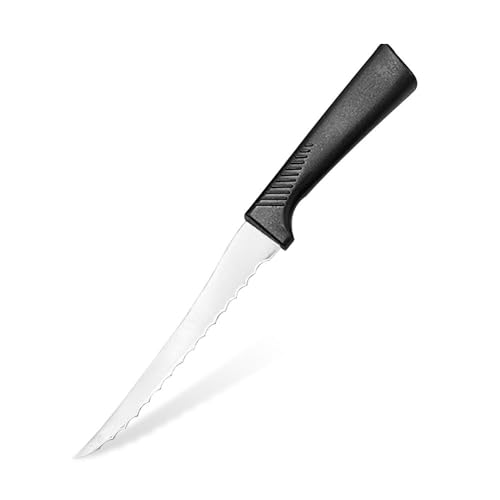
Haokithcun builds its case around a named steel and a broad list of soft-food uses. The 5-inch blade uses X50CrMoV15 high-carbon stainless steel according to the supplied information, with micro-serrations intended for tomatoes, berries, onions, soft bread, citrus, and garnishes. That range makes the knife more useful for a cook who sees a tomato knife as a small utility slicer rather than a single-purpose tool.
The thin tip is described as suitable for piercing, while the handle is intended to reduce hand fatigue. Those are design claims rather than verified ergonomic results, so hand size and grip habits still matter. The knife is listed as dishwasher-safe, although hand washing is recommended for maximum longevity. This creates a convenient compromise for busy households, especially when the knife is used for several small jobs during meal preparation.
Pros
- Five-inch blade offers a useful middle ground for small produce.
- X50CrMoV15 steel is specifically identified.
- Micro-serrated edge is intended for tomatoes and other soft foods.
- Thin tip is listed as useful for piercing and garnish work.
- Dishwasher-safe design provides cleanup flexibility.
Cons
- Hand washing remains the recommended choice for longer service life.
- The listing does not provide blade weight, handle dimensions, or a stated hardness value.
This is a practical option for cooks who slice tomatoes, citrus, berries, onions, and soft bread with the same small knife. The named steel is helpful for comparison, while the missing weight and handle measurements make it difficult to predict the fit for a particular hand. It should be skipped by anyone seeking a table knife with a forked tip or a premium full-tang construction.
To buy this product, click here.
6. Omesata Tomato Knife – Best Textured-Grip Option

Omesata emphasizes handling as much as cutting. The product information describes a textured, non-slip handle and a weighted, balanced design, paired with a serrated high-carbon stainless-steel blade. A grippy surface can be useful around wet tomatoes, where juice and pulp quickly spread across the fingers and handle. Since the listing does not provide a blade length, weight, or alloy designation, the strongest supported distinction is the handle treatment and dedicated serrated format.
The knife is presented for thick or thin tomato slices as well as other fruits and vegetables. That gives it a reasonable role beside a cutting board during salad preparation, sandwich assembly, or a weekend cooking session. Buyers should read “high-carbon stainless steel” as a general material description here rather than assume it matches the performance of a named steel such as T420 or X50CrMoV15.
Pros
- Serrated blade is suited to tomato skin and soft interiors.
- Textured, non-slip handle is a useful feature for wet food preparation.
- Product information describes a weighted and balanced design.
- Intended for both thick and thin slices.
- Suitable for tomatoes, vegetables, and fruits.
Cons
- Blade length and weight are not stated in the available information.
- The steel is described generally without a named alloy or hardness value.
Omesata makes the most sense for shoppers who place a high priority on grip texture and want a dedicated serrated slicer for several produce types. It is harder to evaluate against the more technically documented knives because key dimensions and steel details are missing. If those specifications guide your purchase, the Victorinox, RADA, or PAUDIN provides a clearer comparison.
To buy this product, click here.
7. Yunletwood Tomato Knife 3rd Gen 2-Pack – Best for Keeping a Spare

Yunletwood’s main distinction is quantity: the package includes two tomato knives. That can be useful in a household where one knife stays in the kitchen and another travels to the table, or where a second knife is handy during a larger meal-preparation session. Both are described as serrated stainless-steel tomato knives with lightweight anti-slip handles.
The product information also describes high-carbon stainless steel, dishwasher-safe use, and suitability for thin slices, cubes, and small dice. The listing does not state blade length, weight, or steel grade, so buyers cannot use the available data to compare its physical proportions with the 4.3-inch Victorinox or the several 5-inch models here. Its value is therefore tied to having two dedicated knives and a simple cleanup routine rather than a richly specified blade design.
Pros
- Two knives provide a ready spare or a second table setting.
- Serrated blades are intended for tomatoes, fruits, and vegetables.
- Lightweight anti-slip handles are described in the product information.
- Dishwasher-safe construction supports quick cleanup.
- Suitable for slicing, cubing, and dicing soft produce.
Cons
- Blade length, weight, and exact steel grade are not stated.
- A two-pack may be unnecessary for buyers who need one carefully selected tomato knife.
This pair suits families, shared kitchens, and cooks who often need a prep knife and a table knife at the same time. It is less suitable for a buyer comparing detailed blade geometry or building a collection around one premium tool. Before purchase, check whether the two-knife format solves a real storage or serving need rather than simply adding another pair of similar utensils.
To buy this product, click here.
8. PAUDIN 5-Inch Serrated Tomato Knife – Best for Specified Edge Details

PAUDIN supplies more technical blade information than many dedicated tomato-knife listings. The 5-inch knife uses 5Cr15MoV high-carbon steel, and the product information lists HRC56+ hardness plus hand polishing at 14 to 16 degrees on each side. Those details help a shopper understand the advertised edge configuration, though they should not be treated as independent proof of cutting performance or edge life.
The lightweight format, soft wood handle, and included sheath give the knife a clear practical identity. A five-inch length should provide enough reach for ordinary tomatoes while remaining manageable around a small board. The sheath can be useful for protected storage, but the available information does not state its exact fit or whether it is intended for carrying outside the kitchen. PAUDIN also lists a lifetime warranty against workmanship defects, which may matter to buyers who value a stated support policy.
Pros
- Five-inch blade is a practical size for tomato slicing.
- 5Cr15MoV steel and HRC56+ hardness are specifically listed.
- Double-serrated edge is intended to avoid crushing soft tomato flesh.
- Soft wood handle and lightweight format emphasize control.
- Includes a sheath and a stated lifetime workmanship warranty.
Cons
- Wood handle care requirements are not fully detailed in the available information.
- The listed edge angles are manufacturer specifications, not independent performance measurements.
PAUDIN is a strong match for shoppers who like to see a stated steel, hardness figure, and edge-angle range before buying. It also offers protected storage through the sheath. A buyer who prefers dishwasher cleaning or a table-oriented knife may find the Victorinox more convenient, while someone seeking a full-tang premium model may prefer Wüsthof Classic.
To buy this product, click here.
9. HOSHANHO 5-Inch Japanese Tomato Knife – Best for Documented Japanese-Style Specifications

HOSHANHO is the most technically detailed option in this group for shoppers interested in a Japanese-style tomato slicer. The listing identifies 10Cr15CoMoV high-carbon steel, a stated HRC58 hardness, and a serrated blade hand sharpened at 15 degrees on both sides. The knife is also specified at 5 inches, creating a clear size and edge description for everyday tomato preparation.
The kapok wood handle gives this model a different character from the polypropylene, resin, and textured polymer options elsewhere in the ranking. Wood can appeal to cooks who prefer a warmer traditional material, though the available information does not provide detailed care instructions for the handle. The serrated blade is presented for tomatoes, fruits, and vegetables, while the listing also describes an ergonomic shape intended to follow the palm. That claim suggests a design goal, not a guarantee of comfort for every hand.
Pros
- Five-inch serrated blade is sized for tomato and fruit preparation.
- 10Cr15CoMoV steel is specifically identified.
- HRC58 and a 15-degree-per-side specification are provided.
- Kapok wood handle offers an alternative to synthetic handle materials.
- Product information describes use across tomatoes, fruits, and vegetables.
Cons
- Wood handle maintenance is less clearly documented than the care instructions for several synthetic-handled knives.
- The stated hardness and angle do not independently establish edge retention or cutting performance.
HOSHANHO fits buyers who want a five-inch tomato knife with named steel and stated edge specifications, plus a wood handle. It is less convenient for shoppers who prefer fully documented dishwasher care or a compact 4.3-inch table knife. The Japanese-style description should also be read carefully: the available information identifies the style and materials but does not establish manufacturing origin.
To buy this product, click here.
Buying Guide
Choose Serrations That Start Through the Skin
Tomatoes create a distinctive cutting challenge because the outside can resist a dull or smooth edge while the inside yields quickly. Serrations give the edge multiple points of contact, helping it begin the cut without the heavy pressure that can flatten the flesh. Fine serrations, dual serrations, and micro-serrations can all be suitable, but the product listing must support the description. The Wüsthof Classic specifies fine serrations, while the RADA models identify dual-serrated blades.
Light pressure and a stable tomato matter even with a suitable serrated edge. Use the method for slicing tomatoes without crushing them to assess the cutting setup.
Match Blade Length to Your Cutting Space
A 4.3-inch blade is compact and easy to position around a small board or place setting. Five-inch tomato knives offer more reach for larger tomatoes and repeated slicing, yet they remain shorter than a typical chef’s knife. Think about the scene in which the knife will live. A small apartment board and a breakfast table favor compact handling, while a garden harvest or large sandwich-preparation session may make a 5-inch blade more convenient.
Decide Between Kitchen and Table Use
Some tomato knives are designed to move between preparation and serving. The Victorinox Swiss Classic is explicitly a tomato and table knife, and the Wüsthof Classic includes a forked tip for lifting or serving slices. Dedicated slicers such as the RADA W226 are more focused on cutting. Neither format is universally better. A table knife can reduce the number of utensils at dinner, while a dedicated kitchen model may feel more natural during repeated board work.
Read Steel Descriptions Precisely
Named alloys provide more information than broad phrases such as high-quality stainless steel. The RADA W226 lists T420, Haokithcun lists X50CrMoV15, PAUDIN lists 5Cr15MoV, and HOSHANHO lists 10Cr15CoMoV. These designations still do not predict every aspect of use because geometry, heat treatment, serration shape, and care matter too. A listing that provides no alloy should not be treated as though it uses the same steel as a better-documented competitor.
Plan for Cleaning and Drying
Care instructions can decide whether a tomato knife remains convenient or becomes another chore. RADA’s W226 and the Yunletwood pair are described as dishwasher-safe, while Wüsthof Classic and Mercer recommend hand washing. Haokithcun is listed as dishwasher-safe but recommends hand washing for maximum longevity. Hand washing, rinsing, and drying are especially sensible for knives with wood or less clearly documented handle construction.
Think About Serrated-Knife Sharpening
Serrated knives are maintained differently from plain-edge knives. The grooves between teeth are difficult to treat with a standard flat sharpening stone, and many owners rely on careful use and manufacturer-specific service rather than routine home sharpening. Avoid assuming that a stated edge angle means every sharpening tool will fit the blade. For these products, protecting the edge from glass, ceramic, metal, and other hard surfaces is a practical first step.
Small serrations need an appropriate maintenance route. The guide to sharpening serrated blades explains why an ordinary sharpening slot may be unsuitable.
Best Knife For Tomatoes FAQ
Is a serrated knife better for tomatoes?
A serrated knife is often a practical choice because its teeth can engage the tomato skin without requiring heavy downward force. That helps limit compression of the soft interior. The exact result depends on the serration design, edge condition, blade control, and the tomato itself.
What blade length is best for tomato slicing?
Blades around 4.3 to 5 inches cover most household tomato work. A shorter knife is compact and easy to use at the table, while a 5-inch blade gives a little more reach for larger tomatoes and repeated slices. The right length depends on your cutting board space and whether the knife will also serve as tableware.
Can a tomato knife be used for bread?
Some serrated tomato knives may handle soft bread or small rolls, but they are not automatically substitutes for long bread knives. A short blade may fail to span a large loaf, and a tomato-focused serration pattern may be less suitable for thick crusts. Use the manufacturer’s stated applications as the starting point.
Are tomato knives dishwasher-safe?
Some are listed as dishwasher-safe, including the RADA W226, Yunletwood pair, and Haokithcun model. Others, such as the Wüsthof Classic and Mercer Renaissance, call for hand washing. Follow the care instructions for the exact knife rather than assuming all stainless-steel blades and synthetic handles have identical dishwasher guidance.
Can I sharpen a serrated tomato knife with a regular whetstone?
A flat whetstone does not match each groove of a serrated edge, so it is not a straightforward choice for routine sharpening. Serrated knives may require a suitable tapered tool or professional service, depending on the tooth pattern. Careful cutting on an appropriate board can help avoid unnecessary damage, but it does not replace sharpening when the edge becomes worn.
Is a tomato knife useful for foods besides tomatoes?
Yes. The products in this guide are also described for fruits and vegetables, and some listings mention onions, citrus, berries, soft bread, cheese, or garnishes. A dedicated tomato knife can therefore work as a small serrated utility knife, although its short blade limits its usefulness for large foods.
Are Japanese-style tomato knives made in Japan?
Not automatically. A listing may use Japanese-style terminology or describe Japanese steel without establishing manufacturing origin. The HOSHANHO product information identifies a Japanese-style tomato slicer and a named steel, but the supplied data does not verify that it was manufactured in Japan.
Final Verdict
The Victorinox Swiss Classic 4.3-inch Tomato and Table Knife earns the Best Overall position because it addresses the everyday problem cleanly: a compact serrated blade, a textured non-slip handle, stainless-steel construction, and table-use versatility. It is a sensible choice for a household that wants one small knife for tomato slices, soft fruit, and dinner service. Buyers who need more blade reach or prefer a named steel should look toward the five-inch models instead.
The Wüsthof Classic is the premium construction choice, with fine serrations, a forked tip, full-tang construction, and a stated 58 HRC hardness rating, while the RADA W226 is the focused dedicated slicer with dual serrations and T420 steel. Mercer offers a traditional riveted handle, PAUDIN and HOSHANHO provide more detailed edge specifications, and the Yunletwood pair suits anyone who genuinely needs two knives. Match the choice to your board space, cleaning habits, serving plans, and comfort with serrated-knife care rather than choosing by the word “sharp” alone.
