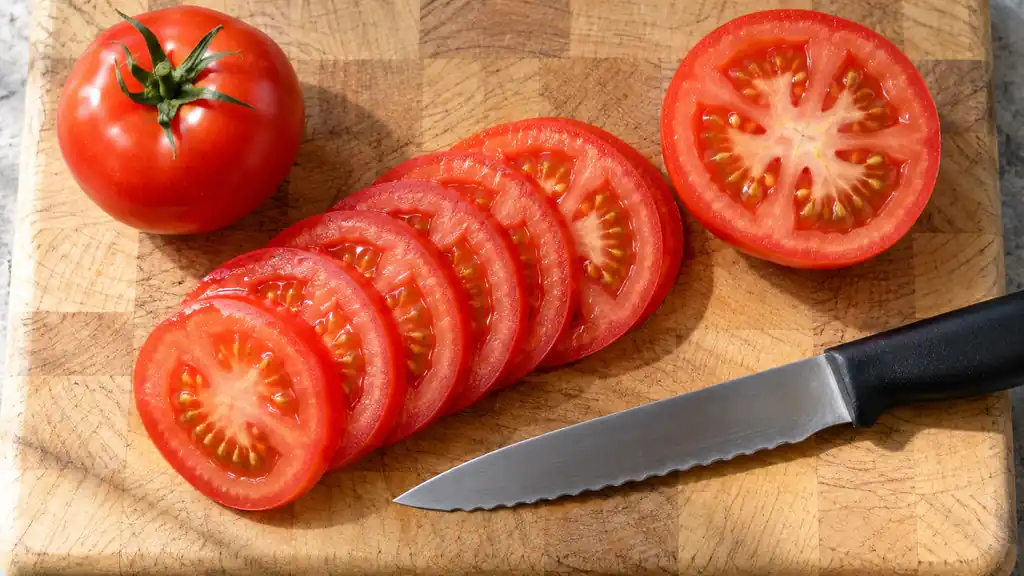
Cut a tomato with a sharp blade and a controlled slicing motion rather than pressing straight down. Keep the fruit stable, start through the skin with light pressure, and let the length of the edge do the work. A small serrated knife is useful when the skin resists a plain edge, but a properly sharpened straight-edged knife can also make clean slices.
A small serrated blade can help start a cut through tomato skin without heavy pressure. Compare tomato knives for clean slices if your current tool keeps slipping; the technique below also explains when a sharp plain edge works well.
Prepare the Tomato and the Cutting Surface
Rinse the tomato, dry its skin, and place it on a board that will not slide. A wet tomato is harder to hold, and a moving board makes an otherwise simple cut unpredictable. Keep the work area clear enough that the blade can finish its stroke without hitting another utensil.
The FDA’s produce-handling guidance recommends washing produce under running water before preparing it, including produce whose skin will be removed. Do not use dish soap on the tomato.
Board material is a separate decision from knife style. The comparison of end-grain and edge-grain cutting boards explains two common wood constructions; whichever board you use, stability and a clean surface come first.
Make Even Round Slices
- Remove the stem. If a firm core needs to come out, keep the tomato on the board and make small, controlled cuts around it. Do not dig toward the hand holding the fruit.
- Choose a stable position. Set the tomato on its side for round crosswise slices. If its shape makes it roll, create a small flat resting surface before continuing.
- Start the edge gently. With a serrated blade, use a short, light back-and-forth stroke to engage the skin. With a sharp plain edge, use a drawing slice. Neither method should require a hard downward push.
- Continue the stroke through the flesh. Keep the holding fingertips curled away from the cutting path. Maintain the slice thickness as the blade moves, rather than squeezing the tomato to force it still.
- Reset between slices. Move the holding hand back before starting the next cut. Stop when the remaining piece is too small to control comfortably; lay it flat instead of pursuing one more upright slice.
A thinner slice needs more support than a thick sandwich slice. If a very ripe tomato collapses during handling, use thicker slices or wedges. The shape of the ingredient places a practical limit on how fine a cut remains useful.
Dice a Tomato Without Making a Puddle
For ordinary dice, first make slices, then cut manageable stacks into strips and cut across those strips. Avoid building a tall, slippery stack. Working with one or two slices at a time is slower but gives the holding hand a more stable job.
For a tomato with a large, loose seed cavity, wedges may be easier to control. Quarter the tomato, lay a wedge on a broad cut face, and cut it into strips before making the crosscuts. If a recipe specifically needs less liquid, remove the loose seeds and gel separately. Seeding is a recipe choice, not a requirement for every diced tomato.
A short knife can help with removing a core or trimming a small blemish. These paring knives for small preparation cuts illustrate that role; a longer or serrated blade may still be more convenient for repeated slices across the whole fruit.
Handle Small Tomatoes One at a Time
For cherry and grape tomatoes, place the fruit on the board and halve it with a controlled cut while keeping fingertips clear. Work with a dry surface and do not balance several loose tomatoes beneath the blade. Speed is less useful than knowing where the knife will finish.
Very small, soft tomatoes are often better halved than finely diced. If the recipe allows it, change the cut to suit the fruit rather than trying to turn every variety into identical cubes.
Why the Knife Slips or Crushes the Flesh
- The edge does not enter the skin. Stop and check the blade’s condition. More pressure increases compression without solving a dull edge.
- The fruit moves. Dry the skin, stabilize the board, and choose a flatter resting position.
- The blade is too short for the stroke. Repeated tiny cuts can tear an unsupported slice. A suitable longer blade may make the motion easier.
- The tomato is exceptionally ripe. Reduce handling and choose a thicker cut. A sound knife cannot restore firmness to soft flesh.
Manufacturer descriptions such as Victorinox’s knife-use guide identify wavy-edged tomato knives for delicate produce. That does not make every serration pattern equally easy to maintain. If an existing serrated knife needs attention, follow the checks in sharpening and maintaining serrated knives instead of using an ordinary sharpening slot without confirming compatibility.
Once the cut is complete, transfer the pieces with a utensil rather than scraping a sharp edge sideways over the board. Clean the knife and board, and refrigerate cut tomatoes promptly when they are not being served immediately.
