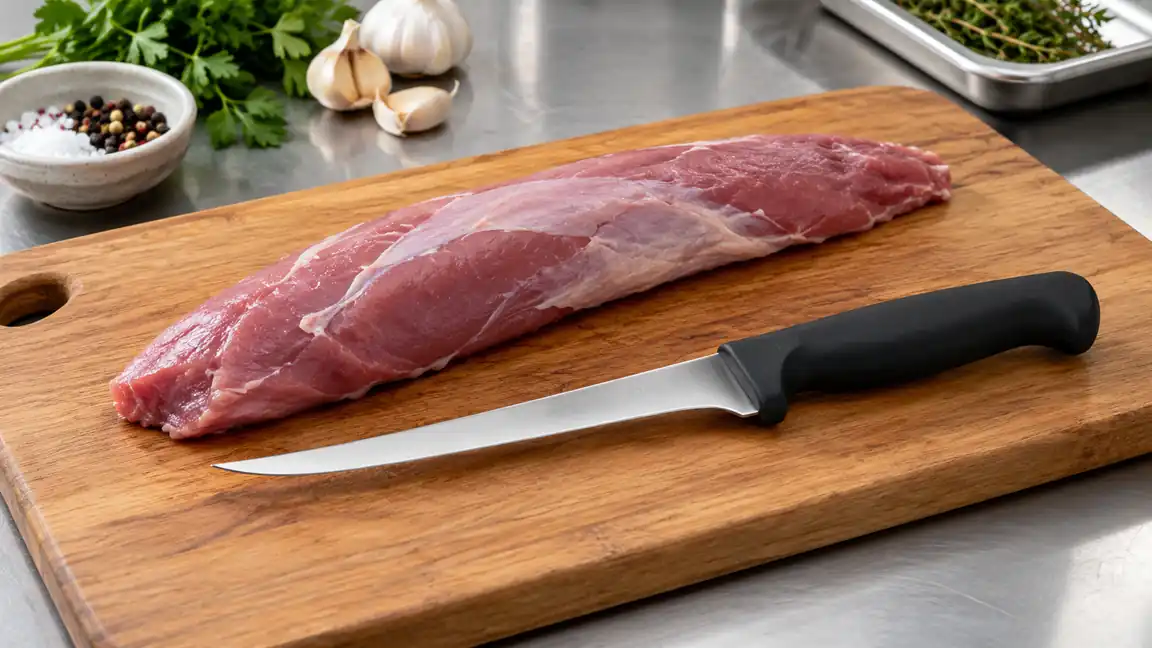
A boning knife earns its place beside a chef’s knife when dinner involves chicken joints, brisket trim, fish skin, or a stubborn strip of sinew clinging to the bone. The right blade lets you work close to the bone with controlled strokes instead of forcing a broad kitchen knife into a narrow space. Buyers often choose by sharpness alone, yet flexibility, blade length, tip shape, handle security, and cleanup habits have a greater effect on whether a knife suits the task.
Boning knives vary from semi-stiff curved blades for beef and pork to thinner flexible blades that follow the contours of fish and poultry. A 5-inch blade can feel nimble around small cuts, while a 9-inch fillet-style blade gives more reach across larger fish. Steel descriptions also need a careful reading. Several knives here list high-carbon stainless steel or Japanese steel without giving a precise alloy designation, so those broad terms should not be treated as proof of identical edge retention or toughness.
This comparison focuses on the supplied product information, matching each knife with the preparation job its design appears to support. Different cooks may prioritize a secure wet-grip handle, a flexible fish blade, a semi-stiff profile for brisket, or simple hand care and a lower purchase commitment. The leading choices below reflect those differences rather than assuming one boning knife fits every cutting board.
Quick Answer
- Victorinox Fibrox Pro Curved Boning Knife: The strongest all-around choice for cooks who want a 6-inch curved, semi-stiff blade for meat, poultry, and selected fish work.
- Victorinox Fibrox Flexible Boning and Fillet Knife: A better match for delicate chicken, fish, and tasks that benefit from a more flexible blade.
- HOSHANHO 9-Inch Fillet Knife: The reach-focused option for larger fish and long, continuous filleting strokes.
Best Boning Knife Comparison Table
| Product | Best For | Blade Length | Flexibility | Handle |
|---|---|---|---|---|
| Victorinox Fibrox Pro Curved Boning Knife | Everyday meat deboning | 6 inches | Semi-stiff | Fibrox, non-slip |
| Victorinox Fibrox Flexible Boning and Fillet Knife | Poultry and delicate fish | 6 inches | Flexible | Fibrox, textured |
| Cutluxe Curved Boning Knife | Trimming and brisket | 6 inches | Flexible | Pakkawood, full tang |
| Mercer Culinary Ultimate White | Simple home meat prep | 6 inches | Curved profile, flexibility not stated | Textured ergonomic handle |
| Mercer Culinary Millennia | Professional-style daily prep | 6 inches | Curved profile, flexibility not stated | Black textured handle |
| Victorinox 5-Inch Curved Boning Knife | Compact, close-control cuts | 5 inches | Not stated | Red Fibrox, TPE |
| HOSHANHO 7-Inch Fillet Knife | Fish and mixed filleting | 7 inches | Flexible | Pakkawood |
| HOSHANHO 7-Inch Boning Knife | Fish, meat, and gift presentation | 7 inches | Flexible | Ergonomic textured handle |
| HOSHANHO 9-Inch Fillet Knife | Large fish and extended strokes | 9 inches | Flexible | Pakkawood |
The detailed reviews explain how each blade profile, length, handle, and maintenance requirement changes the cooking experience.
1. Victorinox Fibrox Pro Curved Boning Knife – Best Overall

The 6-inch Victorinox Fibrox Pro occupies a useful middle ground. Its curved, semi-stiff stainless steel blade has enough structure for working around beef and pork while retaining some flexibility for more delicate trimming. The pointed tip helps pierce meat, and the curved edge creates a practical working angle beside joints and bone. That combination makes it easier to switch from removing meat to trimming fat without changing knives halfway through preparation.
The Fibrox handle is textured and intended to remain secure in wet conditions, a sensible feature for poultry or fish preparation. The available information also lists NSF standards and a lifetime guarantee against defects in materials and workmanship. It is a particularly sensible choice for a household that wants one dedicated boning knife rather than a very soft fillet blade or a heavy butcher knife.
Pros
- 6-inch curved blade suits a broad range of meat preparation.
- Semi-stiff construction supports close work on thicker cuts.
- Pointed tip helps start cuts near joints and bone.
- Textured Fibrox handle is intended for secure handling when wet.
- Listed NSF compliance and lifetime defect guarantee add useful ownership support.
Cons
- Semi-stiff construction is less specialized for very delicate fish filleting.
- The listing does not provide a precise steel designation or hardness value.
This is the most balanced pick for cooks who prepare chicken, pork, beef, and occasional fish on the same counter. Buyers who mainly fillet large fish may prefer a longer flexible blade, while those trimming tiny poultry joints may want the shorter Victorinox below. For mixed household use, its curved profile and semi-stiff character are easier to match to varied tasks than a highly specialized fillet knife.
To buy this product, click here.
2. Victorinox Fibrox Flexible Boning and Fillet Knife – Best for Poultry and Delicate Fish

A flexible blade changes the way a boning knife approaches food. Rather than holding a firm line beside a dense joint, it can follow the contours of poultry or fish more closely. This 6-inch Victorinox is described specifically for thinner and more delicate cuts, making it a strong fit for cooks who regularly break down chicken or prepare fish and want a blade that bends into those curves.
The textured Fibrox handle gives this knife a practical, workmanlike character. The product information identifies the blade as stainless steel and the handle as ergonomic and slip resistant, while also listing NSF approval and a lifetime guarantee against defects. Victorinox recommends compatible sharpeners separately, so ownership involves planning for edge care rather than treating the knife as maintenance-free.
Pros
- Flexible 6-inch blade follows delicate meat and fish contours.
- Curved profile supports trimming and removing meat from bone.
- Textured Fibrox handle is intended to resist slipping.
- Stainless construction is suited to routine kitchen use.
- Listed NSF approval and lifetime defect coverage provide useful support.
Cons
- Flexibility may feel less controlled on dense beef or pork work.
- A compatible sharpener is listed as a separate purchase.
Choose this model for poultry, fish, and fine trimming where blade compliance matters more than a rigid spine. It may be a less comfortable match for heavy joint work or cooks who want a single semi-stiff knife for large cuts. Its role is clear, though, and that clarity is valuable when a flexible blade is the main requirement.
To buy this product, click here.
3. Cutluxe Curved Boning Knife – Best Full-Tang Construction

Cutluxe positions this 6-inch knife for filleting, deboning, trimming, skinning, and butterflying. The supplied information describes a flexible curved blade made from high-carbon German steel, with a full-tang pakkawood handle secured by three rivets. Those construction details matter for cooks who want a substantial handle connection and a knife that can move between meat trimming and fish preparation.
The listed edge angle is 14 to 16 degrees per side, and the product information gives a hardness of 56 or higher on the Rockwell scale. Those are manufacturer-supplied specifications, not independent measurements, but they provide more detail than the broad steel descriptions attached to several competing knives. The laminated and polished handle also suggests a surface intended for kitchen use, though hand washing remains the sensible care approach for a knife with a wood-based handle.
Pros
- Flexible 6-inch curved blade covers several boning and trimming tasks.
- Full-tang construction is paired with a triple-riveted handle.
- Pakkawood handle offers a substantial alternative to molded polymer.
- Published edge-angle and hardness information gives buyers more specification detail.
- Lifetime warranty against material or workmanship defects is listed.
Cons
- Flexible geometry may be less suitable for firm, heavy deboning work.
- Wood-based handle construction calls for careful cleaning and drying.
This knife suits cooks who care about handle construction and want a flexible curved blade for brisket trim, poultry, and fish. Buyers seeking a simple molded handle or a semi-stiff blade may find the Victorinox Fibrox options easier to match. The Cutluxe earns its position through its documented full-tang design and more detailed construction specifications.
To buy this product, click here.
4. Mercer Culinary Ultimate White – Best Simple Home Option
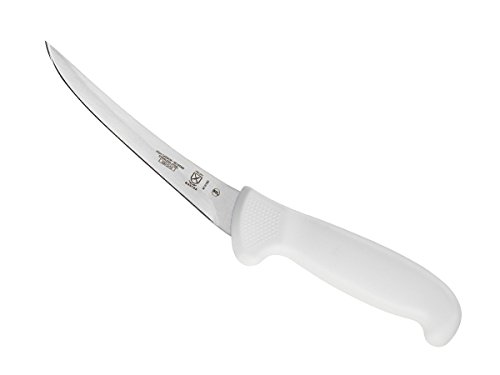
Mercer’s Ultimate White boning knife is a straightforward 6-inch curved tool aimed at separating meat from bone and trimming fat or sinew. Its listed uses include chicken, ham, and fish, so it fits the ordinary household situation where one knife may handle Sunday chicken, a ham joint, and occasional fish preparation. The curved profile helps keep the cutting edge oriented toward the bone rather than forcing a flat chef’s knife into the gap.
The product information describes high-carbon Japanese steel and a handle with textured finger points. Those details point toward easy edge maintenance and a grip intended to remain steady during wet prep, although the listing does not provide a precise steel grade or flexibility rating. Mercer recommends hand washing with mild soap, rinsing, and drying promptly, with no dishwasher or prolonged soaking.
Pros
- 6-inch curved shape is suited to everyday deboning and trimming.
- Listed applications cover chicken, ham, fish, fat, and sinew.
- Textured finger points support a more secure grip.
- High-carbon Japanese steel is described as easy to maintain.
- Hand-care instructions are clear and practical.
Cons
- The available information does not state a precise steel alloy or blade flexibility.
- Dishwasher use and prolonged soaking are specifically discouraged.
This Mercer is a sensible match for a home cook who wants a dedicated boning knife without chasing specialized fish geometry or elaborate handle construction. It is less suitable for someone who needs a documented flexible blade or a long fillet knife. Its appeal comes from a focused design, familiar 6-inch length, and clear care routine.
To buy this product, click here.
5. Mercer Culinary Millennia – Best Textured Work Handle

The Millennia version shares the useful 6-inch curved format found on many practical boning knives, but its black handle gives it a distinct work-focused identity. Mercer describes the blade as one-piece high-carbon Japanese steel and the handle as ergonomic with textured finger points. For someone trimming chicken at a damp counter or working through a ham, those grip details are more relevant than decorative styling.
The intended tasks are broad: separating meat from bone, deboning chicken and ham, handling fish, and trimming fat or sinew. Flexibility is not stated, so it should be viewed as a general curved boning knife rather than a confirmed fish-filleting specialist. Mercer also recommends hand washing and thorough drying, which is a small daily habit that helps keep a dedicated prep tool ready for the next use.
Pros
- Curved 6-inch blade is suited to common meat-preparation tasks.
- One-piece high-carbon Japanese steel construction is listed.
- Textured finger points are intended to improve grip security.
- Designed for chicken, ham, fish, fat, and sinew.
- Hand-wash care guidance is uncomplicated.
Cons
- Blade flexibility is not specified in the available product information.
- The handle and blade are better suited to practical prep than compact storage concerns.
Pick the Millennia if handle texture and familiar Mercer construction matter more than a specialized flexible profile. A fish-focused buyer may get more useful blade behavior from the HOSHANHO or Victorinox flexible models. For routine meat trimming, the Millennia keeps the feature set focused and easy to understand.
To buy this product, click here.
6. Victorinox 5-Inch Curved Boning Knife – Best Compact Design

A 5-inch boning knife changes the feel of close work. The shorter blade gives less reach than a 6- or 7-inch model, yet it can be easier to position around small poultry joints and compact cuts. This Victorinox uses a narrow curved blade and a red Fibrox TPE handle, with the supplied information listing a 12-centimeter blade and a weight of 94 grams.
The product description emphasizes stability, a non-slip handle, and suitability for professionals and hobby cooks. Those claims support a compact, controlled role rather than a large-fish filleting role. Victorinox also lists a lifetime warranty against defects in materials and workmanship, while excluding normal wear and damage caused by improper use.
Pros
- Short 5-inch blade supports close work in tight areas.
- Narrow curved profile is suited to boning and trimming.
- Listed weight is 94 grams, giving buyers a clear size reference.
- Fibrox TPE handle is described as non-slip and ergonomic.
- Lifetime defect warranty is listed.
Cons
- Shorter reach is less suitable for large fish or broad cuts.
- The available information does not state blade flexibility or a precise steel grade.
This is the pick for cooks who prefer a compact tool and often work on smaller poultry or close trimming tasks. Anyone preparing large fish or broad briskets will likely find a longer blade more efficient. Its appeal is control through compact dimensions, not versatility across every size of food.
To buy this product, click here.
7. HOSHANHO 7-Inch Fillet Knife – Best for Mixed Fish and Meat Preparation

This HOSHANHO uses a 7-inch thin blade and is described for filleting, boning, trimming, skinning, and butterflying. The product information identifies 10Cr15CoMoV Japanese stainless steel, a 15-degree-per-side edge, and a flexible, lightweight blade. Those details position it closer to a fish fillet knife than a firm Western meat-boning tool, although the listing also supports use with poultry and other meat.
The pakkawood handle brings a different maintenance profile from a molded Fibrox handle. It is described as durable and resistant to corrosion and abrasion, while the blade’s flexibility is intended to follow fish contours. The 7-inch length offers more reach than compact poultry knives without moving into the extended sweep of a 9-inch fillet blade.
Pros
- 7-inch flexible blade suits fish filleting and mixed preparation.
- Documented 10Cr15CoMoV steel provides a specific material reference.
- Listed 15-degree-per-side edge gives a stated sharpening detail.
- Pakkawood handle provides a substantial grip surface.
- Designed for filleting, skinning, trimming, and butterflying.
Cons
- Flexible blade is less appropriate for forceful work against dense bones.
- Wood-based handle requires more careful cleaning than a fully molded handle.
Choose this model for fish preparation with occasional poultry or meat work. Its flexible blade and 7-inch reach are more specialized than the Mercer knives, while its length remains manageable on a household cutting board. Buyers focused mainly on beef and pork may prefer the semi-stiff Victorinox instead.
To buy this product, click here.
8. HOSHANHO 7-Inch Boning Knife – Best for Flexible Multi-Tasking
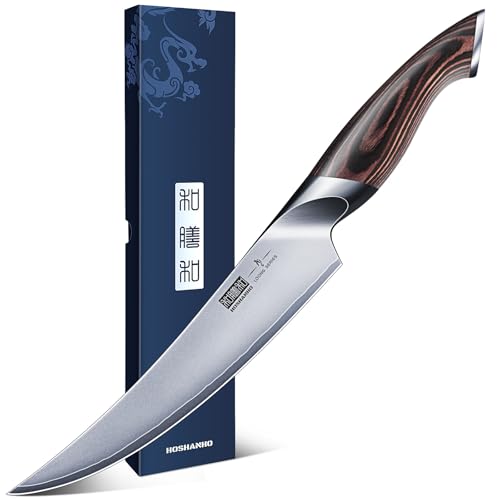
The second 7-inch HOSHANHO listing emphasizes a boning knife identity while retaining a flexible fish-oriented design. It lists the same 10Cr15CoMoV Japanese stainless steel family, a 15-degree-per-side edge, and a handle shaped for a stable grip. The blade is presented for filleting, deboning, skinning, trimming, and butterflying, which gives it a broad role for cooks who move between fish and meat.
The textured handle and wood-grain appearance may appeal to buyers who want a more presentation-friendly knife, especially since the listing describes gift-box packaging. Those details do not change the blade’s underlying application, though. The flexible profile remains better suited to contour-following cuts than hard contact with thick bones, and the available data does not establish an exact hardness value.
Pros
- 7-inch flexible format covers fish and several meat-preparation tasks.
- 10Cr15CoMoV steel is identified in the product information.
- 15-degree-per-side edge is listed.
- Textured ergonomic handle is intended to improve control.
- Gift-box presentation may suit buyers purchasing for a cook.
Cons
- Flexible geometry is not the best match for heavy, rigid deboning work.
- The listing does not provide an exact hardness value or detailed maintenance schedule.
This knife makes sense for a cook who wants a flexible 7-inch blade with broad fish and meat applications and places some value on presentation. The HOSHANHO fillet model above is the more direct fish-focused alternative, while a semi-stiff Victorinox remains easier to justify for dense meat. Treat this model as a flexible generalist, not a bone-cleaving tool.
To buy this product, click here.
9. HOSHANHO 9-Inch Fillet Knife – Best for Large Fish

Length is the defining feature here. The 9-inch thin blade is intended to make longer filleting strokes across larger fish, reducing the need to stop and reposition the knife as frequently. HOSHANHO describes the blade as flexible and lightweight, with the same listed 10Cr15CoMoV Japanese stainless steel and 15-degree-per-side edge found on the shorter fish-oriented model.
The extra reach comes with a practical space requirement. A 9-inch blade needs a clear cutting board and a confident grip, particularly when skinning or following a long rib cage. The pakkawood handle is described as ergonomic and resistant to corrosion and abrasion, but the knife still deserves prompt washing and drying after exposure to fish juices or moisture.
Pros
- 9-inch blade provides useful reach for larger fish.
- Flexible construction is intended to follow fish contours.
- 10Cr15CoMoV steel is specified.
- 15-degree-per-side edge is listed.
- Pakkawood handle is described as durable and ergonomic.
Cons
- Long blade needs more workspace and may feel cumbersome on small cuts.
- Flexible fillet geometry is less suitable for dense, rigid meat-boning tasks.
This is the specialist choice for fishers and cooks who regularly prepare larger fish and want a long continuous blade. It is excessive for small poultry joints and less versatile for brisket trimming than a 6-inch curved boning knife. Its value comes from reach, so the cutting board and food size should justify that extra length.
To buy this product, click here.
Buying Guide
Match Flexibility to the Food
Flexible blades are useful for following the contours of fish, poultry, and delicate cuts. They can help keep the edge close to the bone while removing less usable meat. Semi-stiff blades provide more resistance for beef, pork, and thicker cuts. A flexible fillet knife should not be treated as a substitute for a rigid butcher knife, particularly around hard bone.
Flexibility and profile should match the food. The boning-knife and fillet-knife comparison explains where those categories overlap and where their roles differ.
Choose Blade Length for Your Work Area
Six inches is a versatile middle length for household deboning and trimming. A 5-inch knife can be easier to control around small joints, while a 7-inch blade offers more reach for fish and larger portions. A 9-inch model is most sensible when long filleting strokes are a regular task. Measure the available cutting board space as well as the food you prepare.
Look at the Handle Material and Grip
Textured Fibrox and polymer-style handles are practical around wet ingredients and usually have straightforward care requirements. Pakkawood handles offer a different hand feel and appearance, but they should be washed and dried carefully. Product descriptions such as ergonomic or non-slip indicate intended design features, not a guarantee that every grip will suit every hand.
Read Steel Claims Precisely
Some knives in this group identify 10Cr15CoMoV, while others use broader terms such as high-carbon Japanese steel, high-carbon German steel, or stainless steel. A named alloy gives more information than a geographic marketing description, but steel alone does not determine cutting performance. Blade geometry, heat treatment, edge condition, and maintenance also influence ownership.
Plan for Cleaning and Sharpening
Several products recommend hand washing, rinsing, and thorough drying. That routine is especially sensible for knives with wood-based handles and for any blade exposed to salty fish juices. A boning knife should be sharpened with a method compatible with its edge. Do not assume that a stated edge angle means every household sharpener will reproduce it accurately.
Separate Boning from Filleting
A curved boning knife generally prioritizes close trimming around meat and joints. A fillet knife usually has a thinner, more flexible blade intended to follow fish bones and skin. Some products overlap in their advertised uses, but the blade’s flexibility and length still reveal its stronger application. Select the knife based on the food you prepare most often, rather than the broadest product title.
Best Boning Knife FAQ
What blade length is best for a boning knife?
A 6-inch blade is a practical starting point for mixed household use because it offers a balance between reach and control. A 5-inch knife can suit small poultry and close trimming, while 7- or 9-inch blades are more useful for fish and larger cuts. The best length depends on food size and available cutting space.
Should a boning knife be flexible or semi-stiff?
Choose flexibility for fish, poultry, skinning, and delicate contour work. Choose semi-stiff construction for thicker meat and closer work around firm joints. A semi-stiff model such as the Victorinox Fibrox Pro is more versatile for mixed meat preparation, while the HOSHANHO fillet knives are more specialized toward flexible filleting.
Can a fillet knife be used as a boning knife?
Some fillet knives can trim poultry and meat, and several products in this comparison advertise both uses. Their flexible blades are better for contour-following cuts than for forceful work against dense bones. A dedicated curved or semi-stiff boning knife is usually the safer category match for beef, pork, and heavier joint work.
Is stainless steel suitable for a boning knife?
Stainless steel is a practical choice for a knife exposed to moisture, meat juices, and fish. It still requires cleaning and drying, since corrosion resistance does not mean corrosion immunity. The term stainless steel covers many alloys, so buyers should avoid assuming that two knives with the same broad label have identical edge behavior.
Can these knives go in the dishwasher?
Care instructions vary by product. The Mercer listings specifically recommend hand washing and warn against dishwasher use or prolonged soaking. Wood-based handles also benefit from prompt hand cleaning and drying. Follow the exact instructions associated with the selected knife instead of applying a blanket dishwasher rule.
What should I use to sharpen a boning knife?
Use a sharpening method that matches the knife’s edge and your ability to control the angle. A product listing may state an edge angle, but that does not guarantee compatibility with every pull-through or guided sharpener. Flexible blades also require steady handling during sharpening so the edge does not contact the abrasive unevenly.
Can a boning knife cut through bones?
A boning knife is intended to separate meat from bone and trim around joints, not to chop through hard bones. Forcing a thin or flexible blade into hard bone can damage the edge or create a handling hazard. Work along the bone and use a suitable heavier tool for tasks that require cutting through dense bone.
Final Verdict
The Victorinox Fibrox Pro Curved Boning Knife is the strongest overall match in this group because its 6-inch curved, semi-stiff design covers everyday meat preparation without becoming overly specialized. The pointed tip, wet-grip Fibrox handle, and listed support information make it a practical choice for chicken, pork, beef, and occasional fish work. It gives up some flexibility compared with dedicated fillet knives, but that trade-off supports its broader role.
For delicate fish and poultry, the flexible Victorinox Fibrox model is the clearer alternative. The Cutluxe suits buyers who place greater emphasis on full-tang construction and a pakkawood handle, while the HOSHANHO 9-inch model is the specialist pick for larger fish and longer strokes. Match the blade to the food, keep the edge away from hard bone, wash and dry it promptly, and choose length based on the space and cuts you handle most often.
