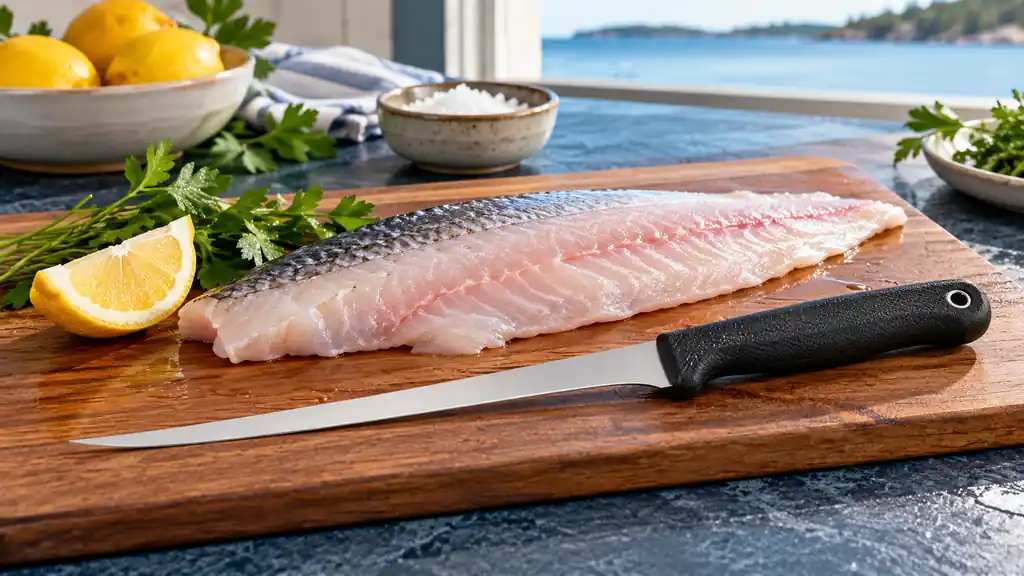
A fish fillet knife has a very specific job: separating delicate meat from skin, ribs, and bones while following the changing shape of a fish. A general kitchen knife can manage a few fish-preparation tasks, but its wider blade and stiffer profile often make it harder to control around the backbone. The right fillet knife gives you a narrow working edge, useful flex, and a handle that remains secure when the cutting board is wet and slippery.
Blade length is one of the first choices to make. A 6- or 7-inch knife suits trout, panfish, bass, and smaller portions, while an 8- or 9-inch blade covers larger sides with fewer strokes. Flexibility matters just as much. A very soft blade can follow the rib cage closely, but too much flex may feel vague around tougher bones. Steel, corrosion resistance, handle texture, sheath design, and cleaning requirements also influence ownership, especially for anglers working beside a boat or outdoor cleaning table.
The nine knives below cover several useful approaches, from the compact Rapala Fish ‘n Fillet and flexible Victorinox Fibrox to the longer Alpedge and the grip-focused BUBBA. Buyers who want a kitchen-friendly handle may prefer the Cutluxe or imarku, while the HOSHANHO 7 Inch offers a well-rounded blend of length, flexible construction, and a narrow fish-oriented blade.
Quick Answer
- HOSHANHO 7 Inch — Best Overall: A narrow 7-inch blade, stated 10Cr15CoMoV steel, flexible construction, and pakkawood handle make it a balanced option for everyday fish preparation.
- Alpedge 9 Inch — Best for Large Fish: The longer blade, full tang, non-slip handle, sheath, and belt clip suit anglers who regularly clean larger fish outdoors.
- Victorinox Fibrox 8-Inch — Best for Controlled Filleting: Its flexible straight-edge blade and textured non-slip handle make it a practical choice for fish cleaning where grip security matters.
Best Fillet Knife For Fish Comparison Table
| Product | Best For | Blade Length | Flexibility | Handle |
|---|---|---|---|---|
| HOSHANHO Fillet Knife | Everyday fish preparation | 7 inches | Flexible | Pakkawood |
| KastKing Speed Demon Pro | Freshwater and saltwater use | 7 inches | Flexible | Non-slip polymer |
| SHAN ZU Genbu Fillet Knife | Fine edge control | 7 inches | Not specified | K133 ergonomic handle |
| Cutluxe Fillet Knife | Fish and meat preparation | 7 inches | Not specified | Triple-riveted pakkawood |
| BUBBA Tapered Flex | Wet outdoor cleaning tables | 7 inches | Tapered flex | Non-slip trigger grip |
| imarku Fillet Knife | Multi-use kitchen work | 7 inches | Flexible | Pakkawood |
| Victorinox Fibrox | Controlled straight-edge filleting | 8 inches | Flexible | Textured non-slip polymer |
| Rapala Fish ‘n Fillet | Compact fishing kits | 6 inches | Not specified | Comfort grip |
| Alpedge Fishing Fillet Knife | Large fish and boat use | 9 inches | Full-length flex | Ribbed PP and TPR |
The detailed reviews explain how each blade length, handle style, steel description, and included sheath fits different fish-cleaning routines.
1. HOSHANHO Fillet Knife 7 Inch – Best Overall

The HOSHANHO 7 Inch is a sensible middle ground for fishers who clean a mixture of smaller and medium-sized catches. Its narrow blade is intended for slicing, skinning, trimming, and following fish contours, while the listed flexible construction should give the edge some ability to track around ribs and the backbone. A 7-inch length keeps the knife maneuverable near the tail and head without feeling as short as a dedicated panfish blade.
The product information lists 10Cr15CoMoV Japanese stainless steel and a hand-polished edge at 15 degrees per side. Those details describe a relatively fine edge design, although they do not establish independent cutting or edge-retention results. The pakkawood handle adds a kitchen-oriented appearance and may appeal to cooks who want one fillet knife for fish and occasional meat trimming. It still needs prompt washing and drying after contact with fish, saltwater, or moisture.
Pros
- 7-inch length suits many everyday fish-cleaning tasks.
- Flexible, narrow blade is intended to follow fish contours.
- 10Cr15CoMoV steel designation is provided in the product information.
- Pakkawood handle offers a substantial kitchen-style grip surface.
- Suitable for filleting, skinning, trimming, and butterflying.
Cons
- Seven inches may feel short for very large fish.
- The wood-based handle requires careful washing and drying.
This is the strongest general recommendation for buyers who want one fish knife that can move between a home kitchen and a basic cleaning station. It has more documented material detail than several competing listings, while the length remains easier to control than a long trophy-fish blade. Buyers who mainly clean salmon, large pike, or broad saltwater fillets may prefer a 9-inch option instead.
To buy this product, click here.
2. KastKing Speed Demon Pro 7-Inch – Best for Wet Fishing Conditions

The 7-inch KastKing Speed Demon Pro takes a distinctly fishing-oriented approach. Its G4116 German stainless steel blade has a corrosion-resistant coating, and the handle uses a non-slip polymer rather than wood. That combination makes sense beside a dock or boat, where fish slime, rinse water, and damp gloves can make a polished kitchen handle awkward to manage.
Its 7-inch flexible format occupies the same general size range as the HOSHANHO, but the ownership details differ. The polymer handle is easier to rinse after a messy cleaning session, and the included sheath has drainage openings intended to help water escape. The product is marketed for fresh and saltwater use, yet the coating should still be treated as added protection rather than a reason to leave the knife wet.
Pros
- 7-inch flexible blade suits a broad range of fish sizes.
- G4116 German stainless steel is specifically identified.
- Non-slip polymer handle suits wet outdoor handling.
- Corrosion-resistant coating is useful around fresh and saltwater.
- Included sheath has openings intended for drainage.
Cons
- Black coating can make scratches or wear more visible over time.
- Outdoor-focused handle styling may feel less refined in a kitchen.
This knife is a strong match for anglers who clean fish at the marina, on a boat, or at an outdoor table. It is easier to pair with wet conditions than a wood-handled model, and the sheath gives the blade a defined storage place between uses. Choose another knife if you want a more traditional kitchen handle or a longer blade for broad fish sides.
To buy this product, click here.
3. SHAN ZU 7 Inch Genbu Fillet Knife – Best for Fine Edge Work

The SHAN ZU Genbu is aimed at buyers drawn to a Japanese-style presentation and a fine, hand-finished edge. Its listing describes Japanese steel, a Honbazuke forging process, and a multi-step manufacturing process. The available information does not provide a specific alloy designation, so the steel description should be read as a broad material claim rather than a complete metallurgical specification.
The 7-inch format keeps this knife in the practical range for smaller and medium fish. Its K133 handle is described as ergonomic, but detailed dimensions and grip material are not provided. That leaves the knife best suited to buyers who value a compact, visually distinctive tool and are comfortable judging handle fit from the product listing. Careful hand washing and drying remain sensible for any knife used around fish juices and water.
Pros
- Compact 7-inch blade is suitable for detailed fish preparation.
- Listing describes a hand-finished edge and Honbazuke process.
- K133 handle is presented as an ergonomic design.
- Japanese-style construction language will appeal to some kitchen users.
- Can be used for fish and general boning tasks.
Cons
- A precise steel alloy designation is not supplied.
- Flexibility and handle dimensions are not clearly documented.
The SHAN ZU makes sense for someone who wants a compact fillet knife with a more decorative Japanese-inspired identity. It is less suitable for buyers who need clearly documented flex characteristics or a heavily textured outdoor grip. Its practical appeal rests on the 7-inch size and stated edge work, while the missing technical details make it harder to compare directly with knives that list their steel.
To buy this product, click here.
4. Cutluxe 7-Inch Fillet Knife – Best for Kitchen and Fish Use

Cutluxe positions this 7-inch knife between a fish fillet tool and a broader kitchen boning knife. The listing describes a tapered edge for filleting, skinning, trimming, and deboning, along with forged high-carbon German steel. It also lists a full-tang construction and triple-riveted pakkawood handle, features that give the knife a more substantial kitchen-tool profile than many lightweight fishing knives.
The stated 14 to 16 degrees per side describes the supplied edge specification, while the listed 56+ Rockwell hardness gives buyers a documented hardness reference. Neither detail alone proves better fish-filleting results, and the listing does not specify a flexibility rating. The pakkawood handle may suit a home prep area, though it deserves hand cleaning and thorough drying rather than careless wet storage.
Pros
- 7-inch blade length suits detailed fish and meat work.
- Forged high-carbon German steel is identified in the listing.
- Full tang and triple rivets support a substantial handle construction.
- Pakkawood handle gives it a kitchen-oriented feel.
- Listed lifetime warranty covers material or workmanship defects.
Cons
- Blade flexibility is not specified for fish-rib work.
- Pakkawood requires more care than a fully synthetic outdoor handle.
This is a useful choice for a cook who cleans fish at home and also trims meat or poultry. The full-tang construction and triple-riveted handle distinguish it from simpler fishing knives, but the missing flex rating matters for buyers who prioritize close rib-cage work. It is better suited to controlled countertop preparation than to being left exposed on a wet boat deck.
To buy this product, click here.
5. BUBBA 7 Inch Tapered Flex Fillet Knife – Best for Grip Security

The BUBBA 7 Inch is built around control in messy fishing conditions. It has a non-slip grip with a trigger-style shape, safety guards, and a 13-inch overall length. Those details matter when a hand is wet, a fish is moving on the table, or the handle needs to stay planted while the blade is drawn along the skin.
The thin 8Cr13MoV stainless steel blade is described as suitable for detailed cutting, and the tapered flex design is intended to help the edge follow fish contours. The listing also includes a synthetic sheath and lanyard hole. Buyers who want a compact kitchen knife with a plain handle may find the fishing-specific shape more pronounced than necessary.
Pros
- 7-inch tapered flex blade suits detailed filleting.
- Non-slip handle and trigger grip support wet-hand control.
- Safety guards help separate the hand from the blade and fish spines.
- 8Cr13MoV stainless steel is identified.
- Synthetic sheath and lanyard hole suit portable fishing use.
Cons
- Trigger-style grip may feel bulky for some kitchen users.
- The 13-inch overall length needs more storage room than a compact knife.
Anglers who put grip security first should give this knife close attention. It is shaped for a fish-cleaning station rather than a minimalist kitchen drawer, and its guards add useful separation during wet work. Buyers who prefer a slimmer handle, a wooden grip, or a less specialized overall profile may be happier with the Victorinox or Rapala.
To buy this product, click here.
6. imarku 7-Inch Fillet Knife – Best Multi-Use Kitchen Option

The imarku 7-inch knife is aimed at buyers who expect their fish knife to handle additional kitchen tasks. Its thin, flexible blade is listed for fish filleting, meat trimming, poultry deboning, and skinning. That broader role can be useful in a home kitchen where a dedicated fish knife may spend more time in a drawer than at an outdoor cleaning table.
The available specifications identify 10Cr15CoMoV composite steel and a stated hardness of 59 ± 2 HRC. That gives the buyer more technical information than a generic “stainless steel” description, although hardness should not be treated as a complete measure of cutting quality or toughness. The pakkawood handle is designed for a comfortable grip, and the mirror-finished areas give the knife a polished appearance that calls for careful cleaning.
Pros
- 7-inch flexible blade covers fish, meat, and poultry tasks.
- 10Cr15CoMoV steel designation is provided.
- Stated hardness of 59 ± 2 HRC offers a documented reference point.
- Pakkawood handle suits home kitchen use.
- Thin blade is intended for precise trimming and deboning.
Cons
- Wood-based handle is less convenient for prolonged wet outdoor use.
- The product information does not state a specific fish-filleting flex rating.
Choose the imarku if you want one narrow knife for occasional fish cleaning plus regular meat and poultry preparation. Its listed steel and hardness information will appeal to detail-oriented buyers, while the 7-inch blade remains manageable around smaller fish. Dedicated anglers may prefer a synthetic grip and sheath, especially if the knife will live in a tackle bag.
To buy this product, click here.
7. Victorinox Fibrox 8-Inch Fillet Knife – Best for Controlled Straight-Edge Filleting
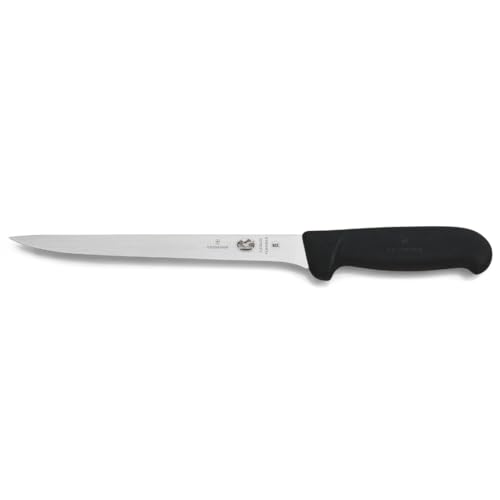
The Victorinox Fibrox brings a straightforward design to fish preparation. Its 8-inch flexible straight-edge blade offers more reach than a 6- or 7-inch model without moving into the longest category. That length can be helpful when drawing one continuous cut along a medium-sized fish, while the straight profile keeps the cutting motion predictable near the skin and rib cage.
The textured black handle is described as slip-resistant even when wet, and the product information lists a stamped stainless steel blade construction. It is also described as hygienic and dishwasher safe. Buyers should still follow the care instructions associated with their exact product and avoid assuming that every knife component has identical dishwasher behavior. The simple design leaves out a fishing sheath, so separate protected storage may be necessary.
Pros
- 8-inch flexible blade offers useful reach for medium fish.
- Straight edge supports controlled filleting strokes.
- Textured handle is described as slip-resistant when wet.
- Stamped stainless steel construction is clearly identified.
- Product information lists hygienic and dishwasher-safe features.
Cons
- No protective sheath is identified in the supplied product information.
- Eight inches may feel long for small panfish or cramped prep areas.
This model fits buyers who want a practical knife for a home fish-preparation station and value a secure synthetic grip. It is a particularly sensible length for someone who finds 6-inch blades limiting but has no need for a 9-inch trophy-fish knife. Pack it with a separate blade guard or sheath for transport, since the supplied information does not list one.
To buy this product, click here.
8. Rapala Fish ‘n Fillet 6-Inch Knife – Best Compact Fishing Choice

The Rapala Fish ‘n Fillet is the compact choice in this group, with a 6-inch blade intended for freshwater and saltwater fish such as bass, walleye, trout, pike, and panfish. Shorter blades give the user more room to make controlled movements around small fish, and they are easier to store in a tackle box or compact kitchen drawer.
The product information lists a full-tang Swedish stainless steel blade, comfort grip, genuine leather sheath, and single-stage sharpener. The sheath gives the knife a defined transport solution, while the included sharpener may be useful for basic edge upkeep. The available data does not specify the blade’s flexibility or the sharpener’s angle, so buyers should avoid assuming that the included tool suits every sharpening preference.
Pros
- 6-inch blade is well suited to smaller fish and tight workspaces.
- Full-tang Swedish stainless steel construction is identified.
- Genuine leather sheath supports protected transport.
- Comfort grip suits basic fishing and fish-cleaning use.
- Single-stage sharpener is included.
Cons
- Six inches may be limiting for broad fillets and large fish.
- Blade flexibility and sharpening angle are not specified.
The Rapala is a logical pick for an angler who mainly handles trout, panfish, bass, or other smaller catches and wants a compact kit. It is easier to carry than a long fillet knife and arrives with useful storage accessories. Buyers who routinely clean large salmon or thick-sided fish should move up to an 8- or 9-inch blade.
To buy this product, click here.
9. Alpedge 9-Inch Fishing Fillet Knife – Best for Large Fish

The Alpedge is the long-blade specialist here. Its 9-inch length and stated full-length flexibility are aimed at larger fish, where a longer stroke can cover more of the side without repeatedly stopping and repositioning. The listing specifically describes use with salmon, northern pike, redfish, snapper, flounder, and catfish, making its intended role clearer than that of a general boning knife.
Its DIN 1.4116 stainless steel, non-stick coating, full tang, ribbed PP and TPR handle, sheath, safety buckle, and belt clip create a package suited to boat or outdoor use. The handle is described as symmetrical for left- and right-handed use, but hand comfort remains personal and the oversized shape may feel large to someone accustomed to a slim kitchen handle. The coating can make cleanup easier, though the blade should still be washed and dried after use.
Pros
- 9-inch blade offers reach for large fish and broad fillets.
- Full-length flex is specifically described for following fish contours.
- DIN 1.4116 stainless steel designation is supplied.
- Ribbed PP and TPR handle is intended for wet-hand security.
- Sheath includes a safety buckle and belt clip.
Cons
- Long blade may be cumbersome for small fish.
- Oversized outdoor handle can take more storage space than a kitchen-style grip.
This knife belongs in the hands of someone who regularly cleans larger fish and wants a dedicated boat-ready setup. The longer blade and full-length flex are more relevant to that task than a compact 6-inch knife, while the sheath and belt clip simplify transport. For trout, panfish, or occasional home use, its extra length is likely unnecessary.
To buy this product, click here.
Buying Guide
Match Blade Length to the Fish You Clean
A 6-inch blade gives close control on trout, crappie, and panfish, where a long edge can feel awkward around the head and tail. Seven inches is a flexible middle choice for mixed household use. An 8- or 9-inch blade becomes more useful on broad fish sides, where a longer stroke can reduce the need to saw back and forth. Length does not replace technique, though, so choose the shortest blade that comfortably spans your usual fillets.
If the knife will also prepare meat, review how boning and fillet knives differ instead of assuming one flexible blade is interchangeable with every boning design.
Look for Useful Flex, Not Maximum Flex
A flexible blade can follow the curve of a rib cage and help separate meat close to the bones. Too much movement can make the edge harder to guide, particularly around the backbone or tougher connective tissue. Product listings do not always provide a measurable flex rating, so distinguish between knives that explicitly describe flexibility and models whose listing simply calls them fillet or boning knives.
Compare Handles for Wet Conditions
Fish preparation creates a demanding grip environment. Water, slime, scales, and gloves can all change how a handle behaves. Polymer, PP, TPR, and textured synthetic grips generally fit outdoor cleaning better than polished wood, while pakkawood handles may feel more natural in a dry home kitchen. A trigger grip or safety guard can add separation from the edge, but it may also require more storage space.
Read Steel Descriptions Carefully
Some products provide a specific alloy designation, such as 10Cr15CoMoV, 8Cr13MoV, DIN 1.4116, or G4116. Others use broad terms such as Japanese steel or German steel without identifying the alloy. A named steel makes comparison easier, but it does not independently prove better cutting performance. Fish knives still need washing, drying, and periodic sharpening, including those described as corrosion resistant.
Plan for Storage and Transport
A sheath is particularly useful when a fillet knife travels in a tackle bag, boat compartment, or outdoor cleaning kit. Drainage openings can help prevent trapped water, while a belt clip or lanyard hole changes how the knife can be carried. Kitchen-oriented knives without a supplied sheath should be stored in a blade guard, knife drawer organizer, or other secure location rather than loose in a drawer.
Keep Maintenance Simple and Consistent
Rinse away fish residue after use, wash the blade according to its care instructions, and dry it before storage. Saltwater deserves prompt attention because corrosion resistance is not the same as corrosion immunity. Use a sharpening method compatible with the knife’s edge, and do not assume an included sharpener has the correct angle for every blade. A clean, dry knife is easier to maintain than one left coated with moisture and residue.
Best Fillet Knife For Fish FAQ
What blade length is best for filleting fish?
Seven inches is a practical general-purpose length for buyers who clean several fish sizes. Six inches offers more control on small fish, while 8 or 9 inches suits broad fillets and larger species. The best choice depends on the fish you handle most often and the amount of room available on your cleaning surface.
Should a fish fillet knife be flexible?
Some flexibility is useful because the blade can follow the ribs and skin more closely. A very flexible blade may feel less controlled around thick bones, while a stiff blade can remove more meat if it cannot follow the fish’s contours. Look for a product that states its flexible or tapered-flex design rather than assuming every narrow knife has the same behavior.
A narrow blade still needs a controlled path along the skeleton. The tutorial on filleting a whole salmon shows where reach, support, and pin-bone removal enter the job.
Is stainless steel a good choice for a fish knife?
Stainless steel is convenient for fish preparation because it offers resistance to moisture and staining. The exact alloy still matters, and stainless steel can corrode when exposed to saltwater and left wet. Wash and dry the knife after each use, even when the product is marketed for saltwater fishing.
Can a boning knife replace a fish fillet knife?
Some boning knives can handle fish, especially when their blades are narrow and flexible. A general boning knife may have a different balance, thickness, or stiffness from a dedicated fillet knife. For frequent fish preparation, a purpose-oriented fillet blade usually gives a more suitable combination of length, narrowness, and flex.
Are wooden handles suitable for fish cleaning?
Wood-based and pakkawood handles can work well in a home kitchen, but they need more careful cleaning and drying than synthetic outdoor grips. They are less convenient if the knife will sit beside a boat or remain exposed to repeated moisture. Buyers who regularly clean fish outdoors may prefer polymer, PP, or TPR handles.
Does a longer fillet knife remove more meat?
Length alone does not determine yield. A longer blade can make broad, continuous strokes on large fish, while a shorter blade may give better control on small fish. Blade flexibility, edge condition, technique, and the fish’s shape all influence how closely the knife follows the bones.
How should a fillet knife be stored?
Store it with a sheath, blade guard, knife block, or another secure system that keeps the edge covered and prevents contact with loose utensils. Outdoor users should allow the blade to dry before closing it inside a sheath. A damp enclosed space can encourage corrosion over time.
Final Verdict
The HOSHANHO 7 Inch earns the Best Overall position because it combines a useful middle-length blade, a listed flexible construction, identified 10Cr15CoMoV steel, and a pakkawood handle suited to home fish preparation. It is a balanced fit for buyers who clean different fish sizes and want a knife that can also handle trimming and related kitchen tasks. The KastKing Speed Demon Pro 7-Inch is the stronger alternative for wet outdoor conditions because of its non-slip polymer grip, coated blade, and draining sheath.
Buyers who work with large fish should move toward the Alpedge 9 Inch, while small-catch anglers may find the compact Rapala more manageable. The Victorinox Fibrox occupies a useful middle position for controlled 8-inch filleting, and the Cutluxe or imarku make more sense for a kitchen that also prepares meat and poultry. Choose by fish size, working environment, handle preference, and storage plan rather than blade length alone. A well-matched knife that is cleaned, dried, and stored safely will serve the task better than a longer or more elaborate model chosen without regard to daily use.
