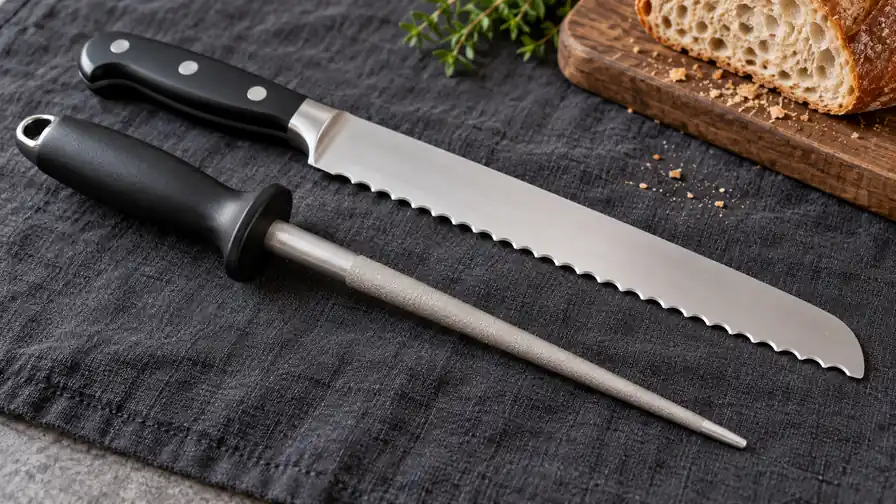
A serrated knife can keep slicing bread, tomatoes, citrus, and crusty pastries long after a plain edge begins to struggle, but its scalloped teeth make maintenance less straightforward. A standard pull-through sharpener may miss the recessed areas, while a straight sharpening stone can touch only the high points. That is why shoppers looking for the Best Serrated Knife Sharpener usually need a tool with a tapered abrasive surface, a dedicated serrated slot, or both.
The main decision is whether you want a focused serration tool or a broader kitchen sharpener that also accepts serrated blades. Tapered diamond rods offer more control over individual gullets and can suit knives with different tooth sizes, while multi-stage countertop sharpeners are quicker for households maintaining several blade styles. Handle security, abrasive grit, storage, and compatibility matter as much as the headline feature. A bread knife used every weekend has different needs from a pocket knife carried on camping trips.
The products below include dedicated diamond sharpeners, compact retractable rods, and multi-purpose manual systems. The DMT Diafold Serrated Diamond Knife Sharpener earns the strongest overall position because its tapered fine diamond surface is purpose-built for serrations of varying sizes, while the other picks serve buyers who value coarse edge repair, countertop stability, portability, or support for several kitchen tools.
Quick Answer
Best Overall: DMT Diafold Serrated Diamond Knife Sharpener offers a tapered 4-inch diamond surface that reaches serrations from approximately 1/4 inch down to 1/16 inch, making it the most focused choice in this group.
Best for Coarse Repairs: DMT FSKC Diafold Serrated Knife Sharpener uses a coarse 45-micron diamond surface for neglected edges and stores inside its folding handles.
Best Countertop Option: Orange Ninja Serrated & Kitchen Knife Sharpener combines a dedicated serrated slot with coarse, medium, and fine stages for households that maintain several knife types.
Best Pocket Tool: SHARPAL 178N 3-In-1 Pocket Knife Sharpener pairs a tapered serrated-edge rod with a straight-edge rod and a groove for hooks or pointed tools.
Best Serrated Knife Sharpener Comparison Table
| Product | Best For | Sharpening Method | Portability |
|---|---|---|---|
| DMT Diafold Fine | Most serrated kitchen knives | Fine tapered diamond, 25 micron | Folding, 5 inches closed |
| DMT FSKC Coarse | Neglected or dull serrated edges | Coarse diamond, 45 micron | Folding, 5 inches closed |
| Orange Ninja 4-Stage | Mixed kitchen knife collections | Dedicated serrated slot plus three stages | Compact countertop design |
| SHARPAL 178N | Outdoor and pocket-knife use | Fine tapered and round diamond rods | Pocket-sized aluminum handle |
| SHARPAL 191H | Stable home sharpening | Carbide, ceramic, and scissor stages | Compact countertop tool |
| Longzon 6-in-1 | Beginners with varied tools | Five-stage manual system | Drawer-friendly countertop design |
| AccuSharp Knife Sharpener | Fast general maintenance | Diamond-honed tungsten carbide | Compact handheld design |
| Wamery Retractable Rod | Portable serrated and straight blades | Tapered diamond rod | Retractable pocket format |
| Wolfride Two-Piece Set | Keeping one tool at home and one outdoors | Retractable diamond rods | Two compact 5.3-inch tools |
The detailed reviews explain how each sharpening method fits different serration patterns, blade conditions, and storage needs.
1. DMT Diafold Serrated Diamond Knife Sharpener, Fine — Best Overall

A serrated edge is made up of high points and recessed gullets, so the useful part of a sharpening rod is the section that can enter those recesses without forcing a uniform width onto every tooth. The DMT Diafold Fine addresses that issue with a 4-inch tapered diamond surface ranging from about 1/4 inch to 1/16 inch. That changing diameter gives it a stronger fit across bread knives, serrated utility knives, and smaller scalloped blades than a single-width abrasive.
The listed fine surface is 25 micron, or 600 mesh, and the tool can be used dry or with water. Its folding handles close around the abrasive section for storage, opening to approximately 9 1/2 inches and closing to 5 inches. That makes it practical for a kitchen drawer, tool box, or camping kit. The same conical surface can also address straight edges and gut hooks, although its clearest advantage remains controlled serration maintenance.
Pros
- Tapered profile reaches serrations of several sizes.
- Fine 25-micron diamond surface suits edge maintenance.
- Folding handles protect the abrasive during storage.
- Can be used dry or with water, without sharpening oil.
- Compact open-and-close format works at home or outdoors.
Cons
- Requires the user to guide the rod through individual serrations.
- Fine abrasive is less suited to heavily damaged edges than a coarse option.
This is the strongest choice for someone who owns a quality bread knife and wants a purpose-built tool rather than a broad pull-through system. It rewards a slower, more deliberate motion, especially when the knife has large scallops that need different sections of the taper. Buyers who want push-button simplicity or a sharpener for scissors and several plain-edge knives may prefer a multi-stage countertop design.
To buy this product, click here.
2. DMT FSKC Diafold Serrated Knife Sharpener — Best for Coarse Edge Repair

A serrated bread knife that has been dragged through hard crusts for months may need more than a light finishing pass. The DMT FSKC uses a coarse diamond surface listed at 45 micron, or 325 mesh, giving it a more aggressive role than the fine Diafold above. That makes this model a sensible match for neglected edges that need material removed before a finer maintenance tool takes over.
Its folding format follows the same practical pattern. The sharpener opens to roughly 9 1/2 inches and closes to 5 inches, with the handles enclosing the diamond surface. The supplied information describes it as suitable for home use, camping, a tool box, or a gardening shed, and it can be used dry or with water. The coarse surface is useful for restoration, but it calls for restraint because a rough abrasive can remove more material than routine touch-up requires.
Pros
- 45-micron coarse diamond surface addresses neglected edges.
- Folding handles help protect the abrasive during storage.
- Portable size suits kitchens, workshops, and camping kits.
- Works without sharpening oil.
- Can be used with water when preferred.
Cons
- Coarse abrasive is less appropriate for frequent light maintenance.
- Manual control is required for consistent work inside each serration.
This model fits a household whose serrated knife has already lost much of its bite, or a user maintaining outdoor tools that see rougher service. It is less appealing as the only sharpener for someone who simply wants occasional fine touch-ups on a lightly used bread knife. A careful owner may pair it with a finer tapered sharpener rather than treating it as a universal finishing tool.
To buy this product, click here.
3. Orange Ninja Serrated & Kitchen Knife Sharpener — Best Multi-Stage Countertop Option

Many kitchens have a serrated bread knife sitting beside chef’s knives, paring knives, and perhaps a pocket knife used for garden work. A dedicated rod is excellent for the bread knife, but it leaves the rest of that collection to another tool. Orange Ninja takes the broader route with four slots: a coarse carbide stage for repair, a medium diamond stage for sharpening, a fine stage for polishing, and a dedicated serrated slot.
The slot-based format gives beginners a clearer sequence than a bare rod, and the handle is described as suitable for left- and right-handed users. Its ABS body is compact enough for ordinary kitchen storage. The trade-off is control. A tapered rod lets the user match each gullet, while a fixed serrated slot offers less information about how much material is being removed from different tooth shapes. The instruction to pull the blade through in one direction also matters for safe, consistent use.
Pros
- Includes a dedicated serrated sharpening slot.
- Three additional stages cover repair, sharpening, and polishing for plain edges.
- Ergonomic design accommodates right- and left-handed users.
- Useful for several kitchen knife categories in one tool.
- Compact ABS construction is convenient for drawer storage.
Cons
- Fixed slots provide less individual control than a tapered diamond rod.
- The multi-stage design is more tool than needed for a single serrated bread knife.
This is a practical fit for a busy household where the sharpener must serve several blades before dinner, especially if different users want a guided process. Someone who owns an expensive serrated knife with unusual tooth spacing may prefer the DMT’s tapered surface. The Orange Ninja is about broad coverage and repeatable steps, not fine-grained control over every scallop.
To buy this product, click here.
4. SHARPAL 178N 3-In-1 Pocket Knife Sharpener — Best Portable Multi-Tool

A tapered rod is especially useful for a serrated knife carried outdoors because it can reach small recesses without taking up the space of a bench sharpener. The SHARPAL 178N places a tapered diamond rod inside a compact aluminum handle, alongside a round diamond rod for straight edges. It also includes a groove for fishhooks and pointed tools, making the package relevant to anglers, hikers, hunters, and campers.
The available specifications list a 600-grit, 25-micron diamond surface, with a 4-inch round shaft and a 3.5-inch tapered rod. Both rods store inside the handle when not in use, and the tool includes a lanyard hole and storage pouch. There is no need for water or oil. The small dimensions help on a trail or in a tackle box, although a short rod gives less working length than a full-size sharpening tool.
Pros
- Tapered rod is intended for serrations and gut hooks.
- Round rod also handles straight-edge maintenance.
- 600-grit diamond surface supports fine sharpening work.
- Aluminum handle encloses both abrasive rods.
- Lanyard hole and pouch support portable storage.
Cons
- Shorter working sections provide less room than a full-size sharpener.
- Its hook and outdoor-tool features may be unnecessary for kitchen-only use.
This is a smart choice for someone who moves between a serrated camping knife, a pocket knife, and fishing equipment. A homeowner sharpening one long bread knife at a counter may find a longer tapered tool easier to position. The 178N earns its place through compact versatility, especially where every inch of pack space matters.
To buy this product, click here.
5. SHARPAL 191H Knife Scissors Sharpener — Best for Stable Countertop Use

Rod sharpeners demand one hand to hold the tool and another to guide the knife, which can feel awkward near a long bread knife. The SHARPAL 191H takes a different approach with a suction base intended to hold the sharpener on a smooth, flat surface. Its three stages include tungsten carbide for setting an edge, ceramic for honing, and a separate tungsten carbide blade for scissors.
The product information describes the body as compact and suitable for either hand. Its serrated compatibility is part of a broader design for straight, serrated, and kitchen knives, but the supplied details do not specify the dimensions or tooth spacing the serrated feature accepts. That makes it a convenient household tool rather than the most technically specific choice for unusual scalloped blades. The stable base is the feature to prioritize here, especially for users who prefer a countertop workflow.
Pros
- Suction base is intended to stabilize sharpening on a smooth surface.
- Includes carbide and ceramic stages for different maintenance tasks.
- Provides a separate scissor-sharpening function.
- Compact body stores easily in a kitchen.
- Designed for right- and left-handed use.
Cons
- Available information does not specify the serration sizes it accepts.
- Suction performance depends on a smooth, flat countertop.
This sharpener suits home cooks who want a more anchored setup and maintain scissors alongside kitchen knives. It is less compelling for someone who wants to study each gullet with a tapered diamond surface. Before using it, the owner should place it on a suitable smooth surface and confirm that the serrated knife sits correctly in the relevant stage.
To buy this product, click here.
6. Longzon 6-in-1 Knife Sharpener — Best for Beginners With Mixed Tools

Some households need one compact station for chef’s knives, paring knives, scissors, and a serrated blade that comes out for bread or tomatoes. The Longzon system is built around that broad use case. Its five-stage manual design uses tungsten and ceramic slots, includes a dedicated scissor function, and is supplied with a cut-resistant glove. A non-slip base and ergonomic handle are intended to make one-direction pulling easier for new users.
The glove and base address two common beginner concerns: keeping the hand away from the blade and keeping the sharpener from sliding across the counter. Those features do not eliminate the need for careful handling, and the product information does not specify the exact abrasive or serration dimensions for each stage. Still, the all-in-one arrangement can feel less intimidating than a loose sharpening rod when the kitchen drawer contains several blade styles.
Pros
- Five-stage format covers several household sharpening tasks.
- Includes a dedicated scissor slot.
- Non-slip base supports countertop use.
- Cut-resistant glove is included for added hand protection.
- Ergonomic handle is intended for right- and left-handed users.
Cons
- Exact serration compatibility and abrasive specifications are not provided.
- Its larger feature set may be excessive for a single bread knife.
This model is aimed at a beginner who wants a single drawer-friendly tool and values guidance over manual control. It may be a poor match for a serrated knife with a specialized tooth pattern, where a tapered rod gives clearer control. For ordinary mixed kitchen maintenance, its broad layout and included safety accessory make it easier to organize the sharpening routine.
To buy this product, click here.
7. AccuSharp Knife Sharpener — Best for Quick General Maintenance

The AccuSharp uses a handheld format with diamond-honed tungsten carbide sharpening blades and a full-length finger guard. Its listed compatibility includes straight and serrated knives, along with chef’s knives, paring knives, filet knives, and cleavers. The sharpening blades can be reversed, which the product information presents as a way to extend the usable life of the sharpening assembly.
Unlike a tapered rod, this design does not ask the user to work inside each scallop individually. That can make quick routine maintenance more approachable, though it also means the user has less direct control over the exact interaction with different serration profiles. The handle is shaped for either hand, and the sharpener can be cleaned with soap and water according to the supplied information. Dishwasher cleaning is also listed, but owners should still follow the product’s care instructions for their specific use.
Pros
- Listed for both straight and serrated knives.
- Diamond-honed tungsten carbide sharpening elements are reversible.
- Full-length guard helps separate fingers from the blade path.
- Ambidextrous ergonomic handle supports either hand.
- Compact format is convenient for quick kitchen maintenance.
Cons
- Fixed sharpening blades provide less gullet-by-gullet control than a tapered rod.
- It is a general-purpose sharpener rather than a serration-specific specialist.
This is a reasonable pick for a household that wants a fast, compact tool for several knife categories and does not want to learn rod technique. Owners of delicate or unusual serrated edges may prefer the DMT or SHARPAL tapered tools. The AccuSharp’s appeal is its straightforward handheld format, especially for routine upkeep rather than detailed edge restoration.
To buy this product, click here.
8. Wamery Serrated Knife Sharpener — Best Compact Retractable Rod

The Wamery uses a retractable diamond-coated rod with a tapered section for serrations and micro-serrations. Its flat or half-round section is intended for plain edges, so one small tool can travel between a bread knife and a pocket blade. That combination is useful for someone who wants a dedicated rod without carrying a longer folding sharpener.
The compact black pocket format suits camping, fishing, hunting, and kitchen storage. A tapered rod requires the user to match the abrasive diameter to the recessed part of each serration, which gives more control than a fixed slot but also demands attention. The available product information does not list the rod length, grit, or a storage lock, so buyers should focus on its retractable format and dual serrated/plain-edge role rather than assume a particular finish level.
Pros
- Tapered diamond rod reaches serrations and micro-serrations.
- Flat or half-round section supports plain-edge maintenance.
- Retractable design protects the rod during storage.
- Compact format suits outdoor kits and kitchen drawers.
- Works across bread and pocket-knife applications.
Cons
- Grit and exact rod dimensions are not specified in the available information.
- Manual rod control may take practice for consistent serration work.
Choose this model for portability and basic flexibility. It makes sense in a camping box or a small apartment where storage space is tight. A buyer seeking documented grit, a longer working surface, or a folding handle that fully encloses the abrasive may be better served by one of the DMT options.
To buy this product, click here.
9. Wolfride Two-Piece Serrated Knife Sharpener Set — Best Two-Location Set

A two-piece set has a simple advantage: one retractable sharpener can stay in the kitchen while the other lives in a tackle box, camping kit, or workshop drawer. Wolfride supplies two diamond sharpeners, each approximately 135 millimeters, or 5.3 inches, long. The pen-like retractable shape helps keep the tools compact, and the polypropylene handles are described as non-slip for a more secure grip.
The semi-circular surface includes grooves intended for serrated blades and small pointed tools such as fishhooks and needles. The listing also describes use with scissors and large or small kitchen knives. That range gives the set practical flexibility, but the available information does not state a grit or specify which serration dimensions each rod accommodates. Buyers should therefore see this as a convenient maintenance pair rather than a fully documented precision system.
Pros
- Two tools allow separate home and outdoor storage.
- Retractable pen-style bodies are easy to carry.
- Approximately 5.3-inch length keeps each sharpener compact.
- Diamond material is described as wear- and corrosion-resistant.
- Grooved semi-circular surface supports serrated blades and small pointed tools.
Cons
- Available information does not specify the abrasive grit.
- Two compact rods offer less documented control than the DMT tapered sharpener.
This set is useful for a buyer who regularly moves between a home kitchen and outdoor activities. It is also convenient for keeping a spare close at hand when a serrated knife needs attention. Someone looking for a single high-information sharpening tool with a specified taper and grit should choose the DMT or SHARPAL 178N instead.
To buy this product, click here.
Buying Guide
Match the Abrasive to the Knife’s Condition
A fine diamond surface is generally the more logical starting point for a serrated knife that still cuts but has begun to drag through bread crust or tomato skin. The DMT Fine and SHARPAL 178N provide documented 25-micron, 600-grit surfaces for controlled maintenance. A coarse 45-micron surface, such as the DMT FSKC uses, is better suited to an edge that has been neglected, but it should not become an automatic choice for every touch-up.
Choose Between a Tapered Rod and a Guided Slot
A tapered rod lets you place the abrasive inside individual serrations and adjust the working diameter as the tooth shape changes. That is valuable for knives with varied or unusual scallops, although it requires a steady hand and a willingness to work slowly. A guided slot is easier for a quick household routine, especially on multi-stage systems such as Orange Ninja or Longzon, but the available information may not reveal the exact serration sizes those slots accept.
Separate Sharpening From Honing and Polishing
Product listings often group sharpening, honing, repairing, and polishing together, but these actions do different jobs. Coarse carbide or diamond stages remove more material while establishing an edge. Fine diamond or ceramic stages refine an existing edge. A serrated knife should be treated according to its actual condition rather than pulled repeatedly through every available stage.
Serration size and the ground faces govern tool compatibility. The guide to maintaining and sharpening serrated knives explains the checks to make before applying an abrasive.
Check the Working Length and Storage Design
A 4-inch tapered surface can be enough for many kitchen tasks, while a retractable pocket tool favors portability over a long working area. Folding DMT sharpeners close to about 5 inches and protect the abrasive inside their handles. Wamery and Wolfride use retractable formats, while the SHARPAL 178N stores its rods inside an aluminum handle. A countertop model may be easier to hold, but it needs a stable, suitable surface and drawer space.
Think About the Rest of Your Knife Collection
If the only problem blade is a serrated bread knife, a specialized tapered diamond rod is usually the most direct match. A kitchen with chef’s knives, paring knives, scissors, and outdoor blades may benefit from a multi-purpose system. The Orange Ninja, SHARPAL 191H, Longzon, and AccuSharp all extend beyond serrated edges, but their broad compatibility does not automatically provide the same level of serration-by-serration control as a tapered tool.
Use Safe, Deliberate Technique
Keep the knife and sharpener under control, follow the product’s direction of travel, and avoid pushing a blade back and forth through a slot unless the instructions specifically permit it. A cut-resistant glove can add a layer of protection, but it should not be treated as cut-proof. For a rod, match the taper to the recessed portion of the serration and use light, measured passes rather than forcing the abrasive into a narrow gullet.
Best Serrated Knife Sharpener FAQ
Can a regular knife sharpener sharpen a serrated knife?
Some general-purpose sharpeners list serrated compatibility, but the design matters. A fixed pull-through slot may work for the serrations it was built to accept, while a tapered diamond rod can reach individual recessed sections more directly. Check the product’s stated compatibility rather than assuming a sharpener for plain edges will maintain every serrated profile.
Is a diamond rod suitable for a bread knife?
Yes, a tapered diamond rod is a common format for serrated blades because its changing diameter can reach different gullet sizes. The user needs to place the rod in the recessed portion of each tooth and avoid grinding the outer peaks unnecessarily. A fine rod suits routine maintenance, while a coarse surface is more appropriate when the edge is substantially neglected.
Should I sharpen every serration individually?
With a tapered rod, working through the serrations individually gives better control over where the abrasive contacts the blade. The exact motion depends on the knife and sharpener instructions. A guided serrated slot may use a different process, so follow that tool’s directions instead of applying rod technique automatically.
What is the difference between the two DMT Diafold models in this guide?
The DMT Fine uses a 25-micron, 600-mesh diamond surface for finer maintenance, while the DMT FSKC uses a coarser 45-micron, 325-mesh surface for restoring neglected edges. Both use folding handles and a compact format. The choice depends mainly on the edge’s condition and whether you need refinement or more initial material removal.
Are retractable sharpeners good for camping?
Retractable tools are convenient for camping because the abrasive section stores inside a compact body and takes little room in a pocket or kit. Wamery and Wolfride are built around that format, while the SHARPAL 178N stores its rods inside an aluminum handle. Their portability comes with a shorter working area and more dependence on careful hand control.
Can a serrated sharpener also maintain a plain-edge knife?
Some can. The Wamery includes a flat or half-round section for straight blades, the SHARPAL 178N has a round rod, and several countertop models include separate plain-edge stages. A serrated slot or tapered section should not automatically be used on a plain edge unless the product specifically describes that function.
Is a cut-resistant glove required when sharpening?
A glove is not a substitute for controlled handling, but it can provide an additional protective layer. Longzon and the Kitchellence-style three-stage product include a glove, while other sharpeners do not. Keep fingers clear of the edge, stabilize the tool properly, and follow the sharpener’s instructions regardless of whether a glove is supplied.
Final Verdict
The DMT Diafold Serrated Diamond Knife Sharpener, Fine is the strongest overall match for this category because its tapered 4-inch diamond surface is documented for serrations ranging from roughly 1/4 inch to 1/16 inch, and its 25-micron surface suits controlled maintenance. It also folds to a compact 5-inch size and can be used dry or with water. For a neglected edge that needs more aggressive work, the coarse DMT FSKC is the more suitable alternative.
Households with several blade styles may prefer the Orange Ninja’s dedicated serrated slot and additional repair, sharpening, and polishing stages. Outdoor users have a stronger reason to choose the SHARPAL 178N, Wamery, or Wolfride retractable designs, while the SHARPAL 191H and Longzon favor stable countertop routines. Match the tool to the knife’s tooth pattern, condition, and storage setting, then use light, controlled passes rather than treating every serrated edge like a plain blade.
