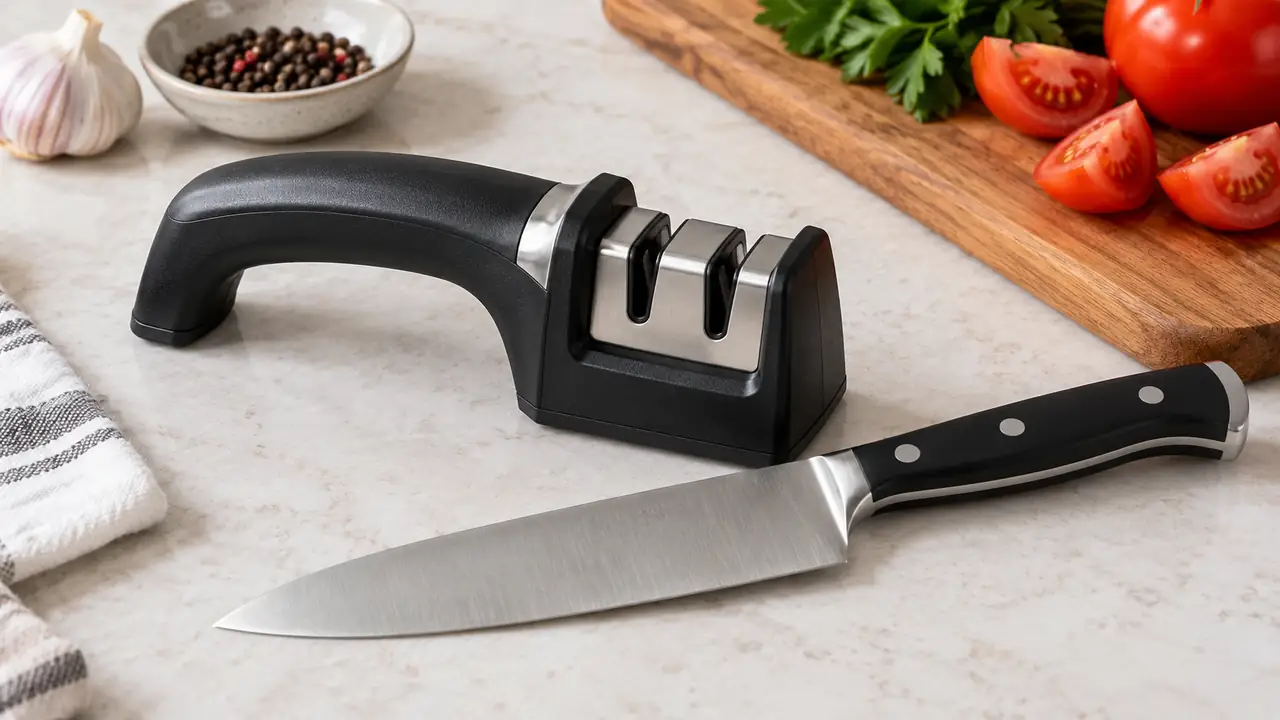
A dull kitchen knife often announces itself with a crushed tomato, a ragged onion, or the faint squeak of a blade dragging across a cutting board. A pull-through sharpener appeals to cooks who want a guided fix without learning freehand stone technique. The appeal is straightforward: place the knife in the slot, draw it through with controlled pressure, and move from a coarse stage to a finer stage when the design calls for it.
The catch is that pull-through sharpeners are not interchangeable. Some use ceramic abrasives for staged refinement, while others use diamond or tungsten-carbide components that remove material more aggressively. Fixed-angle slots can be convenient for common double-bevel kitchen knives, but an adjustable guide may suit households with different blade geometries. Serrated knives, scissors, single-bevel Japanese knives, and delicate edges also need careful compatibility checks. A stable base, finger clearance, handle shape, cleaning method, and storage footprint matter every time the sharpener comes out of the drawer.
The nine options below focus on manual pull-through designs and closely related countertop sharpeners from the supplied product information. The Work Sharp model earns the leading position for its diamond two-stage system and broad kitchen-knife compatibility, while adjustable models from Smith’s and Sharp Pebble offer more angle control. Buyers who value a glove, scissor slot, compact portability, or simple ceramic stages will find different strengths elsewhere.
Quick Answer
Work Sharp Pull Through Kitchen Knife Sharpener is the strongest overall match for most home kitchens because its two-stage, angle-guided design uses diamond grinding rather than carbide shearing and is listed for chef, paring, serrated knives, and shears.
Smith’s Adjustable Manual Knife Sharpener is the better fit for shoppers who want several angle settings, a dedicated serrated slot, and replaceable abrasive components. For a straightforward ceramic system, Henckels Handheld Knife Sharpener keeps the process simple with labeled coarse and fine stages.
Best Pull Through Knife Sharpener Comparison Table
| Product | Best For | Stages | Angle or Compatibility |
|---|---|---|---|
| Work Sharp Pull Through Kitchen Knife Sharpener | Everyday kitchen knives | Coarse and fine | Angle-guided, serrated and shears listed |
| Zwilling 4-Stage Ultra-Sharp Knife Sharpener | Western and Asian-style blades | Four stages | Coarse and fine ceramic grits |
| Smith’s Adjustable Manual Knife Sharpener | Multiple edge angles | Coarse and fine | Six settings, 14 to 24 degrees |
| Sharp Pebble 5 Precision Adjust Knife Sharpener | Straight-edge knives | Three stages | Five settings, 12 to 24 degrees |
| RazorSharp Knife & Scissor Sharpener | Adjustable guided sharpening | Guided sharpening system | Adjustable, 14 to 24 degrees |
| Henckels Handheld Knife Sharpener | Simple ceramic sharpening | Coarse and fine | Fixed guided slots |
| AccuSharp Knife Sharpener | Compact general use | Single pull-through system | Straight and serrated knives listed |
| Longzon 5-in-1 Kitchen Sharpener | Blades and scissors | Four stages | Scissor, coarse, fine, precision slots |
| Zwilling Knife & Scissor Sharpener | Knives plus scissors | Four knife stages plus scissor slot | Western and Japanese-style blades listed |
The detailed reviews explain how each sharpening system differs, along with the blade types and maintenance habits each one suits best.
1. Work Sharp Pull Through Kitchen Knife Sharpener – Best Overall

The Work Sharp model is the most convincing all-purpose choice in this group because its central sharpening method is clearly described. The coarse and fine stages use diamond abrasives, and the product information distinguishes that approach from carbide components that shear material from an edge. For a cook reviving a chef’s knife before chopping vegetables, the angle-guided slots remove the need to hold a sharpening angle by hand.
Its listed compatibility is unusually broad for a compact manual sharpener. Chef, paring, utility, serrated kitchen knives, and shears are all included in the stated application range. That does not mean every blade should be treated identically. Serrated edges deserve a careful pass through the supported slot, while a coarse stage should be reserved for an edge that genuinely needs repair. The small countertop footprint also makes it easy to keep near the cutting board rather than burying it in a drawer.
Pros
- Uses diamond abrasives in a two-stage system.
- Angle-guided slots simplify manual sharpening.
- Listed for chef, paring, utility, serrated knives, and shears.
- Compact enough for countertop or drawer storage.
- Separates coarse repair from fine refinement.
Cons
- Two stages provide less adjustment than the angle-selectable models.
- The available information does not specify the exact guide angle.
This is the sensible starting point for a household with several ordinary kitchen knives and a preference for a guided manual tool. It is less suitable for buyers who need a precisely documented angle or who own specialized single-bevel blades. Used with light, controlled passes, it offers a practical middle ground between a basic carbide pull-through and a more involved sharpening setup.
To buy this product, click here.
2. Zwilling 4-Stage Ultra-Sharp Knife Sharpener – Best for Western and Asian-Style Blades

Four labeled stages give this Zwilling sharpener a more segmented process than the simpler two-stage designs. The supplied information identifies coarse and fine ceramic grits and says the unit is intended for Western and Asian-style blades. That combination may appeal to a kitchen containing a conventional chef’s knife beside a thinner Japanese-style utility or vegetable knife, although the broad style description does not establish compatibility with every specialized edge.
The physical layout focuses on control. A comfortable handle keeps the hand away from the blade path, and the non-slip bottom helps hold the sharpener in place during a pass. A cook restoring a knife after a busy weekend of meal preparation may appreciate the clearly separated stages, while someone who wants a quick touch-up may find four stages more involved than necessary. Cleaning is simple, but the unit is listed for damp-cloth cleaning rather than dishwasher use.
Pros
- Four-stage format gives a clear repair-to-refinement sequence.
- Ceramic coarse and fine grits are listed.
- Intended for Western and Asian-style blades.
- Finger-protective handle and non-slip base support controlled use.
- Damp-cloth cleaning is straightforward.
Cons
- It is not listed as dishwasher-safe.
- The available information does not identify exact angle settings.
This option suits cooks who prefer a structured sharpening routine and own a mixed collection of conventional kitchen knives. It may be unnecessary for a person who wants a tiny emergency sharpener with one simple path. Buyers with a single-bevel Japanese knife should seek explicit compatibility before using any pull-through system, since “Asian-style” is a broad category rather than a guarantee for every Japanese blade construction.
To buy this product, click here.
3. Smith’s Adjustable Manual Knife Sharpener – Best for Multiple Angle Settings

Smith’s stands out for its adjustable guide rather than a fixed sharpening path. The product information lists six settings from 14 to 24 degrees, with adjustable coarse and fine components for straight-edge knives. That range gives a household more control when the drawer contains blades with different intended edge geometries. The exact setting should still be chosen with the knife’s existing edge and manufacturer guidance in mind, rather than treated as a universal performance dial.
A separate fixed-angle slot is listed for serrated blades, which makes the system more useful than an adjustable straight-edge tool alone. Its audience extends beyond the kitchen too, with fillet, pocket, hunting knives, and hooks named in the product description. Replaceable carbide and ceramic components may also reduce the need to discard the entire sharpener after the abrasive parts wear, though the available information does not state replacement cost or service procedure.
Pros
- Six adjustable settings cover 14 to 24 degrees.
- Separate coarse and fine stages support staged sharpening.
- Dedicated fixed-angle slot is listed for serrated blades.
- Replaceable carbide and ceramic components are specified.
- Non-slip base and soft-grip handle aid stability.
Cons
- Adjustable settings add decisions that may slow down beginners.
- The system is broader than needed for a kitchen containing only one common blade type.
Smith’s is a strong pick for a cook who maintains chef’s knives alongside pocket, fishing, or outdoor blades. The angle range is its meaningful advantage, while the replaceable components give the design a maintenance path beyond simple disposal. A beginner who wants only labeled slots may prefer Henckels, and owners of specialized single-bevel knives should not assume the adjustable range makes this tool suitable.
To buy this product, click here.
4. Sharp Pebble 5 Precision Adjust Knife Sharpener – Best for Straight-Edge Angle Control
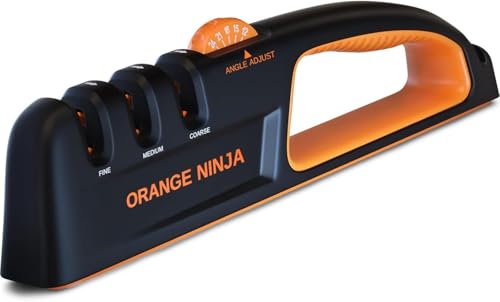
The Sharp Pebble system puts angle selection at the center of its design. Five settings are listed at 12, 15, 18, 21, and 24 degrees, with three stages for repair, restoration, and polishing. That level of choice may be useful for a household with straight-edge kitchen, pocket, and hunting knives. It also gives the user a reason to pay attention to the existing edge rather than pulling every blade through the same fixed slot.
Its restriction is equally clear. The product is intended for straight-edge blades and is specifically listed as unsuitable for serrated knives and scissors. A cook who mainly sharpens chef’s, paring, or utility knives may appreciate that focus, while someone with bread knives or kitchen shears will need another tool. The handheld ABS construction and guided slot format keep the process familiar, but angle adjustment does require more care than a two-stage sharpener with a single path.
Pros
- Five selectable settings span 12 to 24 degrees.
- Three stages separate repair, sharpening, and polishing.
- Suitable for straight-edge kitchen, pocket, and hunting knives.
- Guided slots remove the need to hold the blade angle manually.
- Handheld format stores easily in a kitchen drawer.
Cons
- It is unsuitable for serrated knives and scissors.
- More angle choices may create a learning curve for new users.
This is a good fit for someone who owns several straight-edge knives and wants more control than a fixed-angle kitchen sharpener provides. It is a poor single-tool solution for a mixed kitchen with serrated bread knives. Buyers should select an angle with restraint, use the coarsest stage only when needed, and avoid assuming that the smallest listed angle is automatically the best one for every blade.
To buy this product, click here.
5. RazorSharp Knife & Scissor Sharpener – Best Adjustable Diamond-Ceramic System

RazorSharp uses an adjustable guide paired with diamond-coated ceramic sharpening surfaces. Its stated range is 14 to 24 degrees, which places it in the same broad angle family as Smith’s while using a different abrasive description. The adjustment knob can help a cook maintain several straight-edge knives with different edge preferences, provided the user knows which setting is appropriate for each blade.
The frame includes a sturdy handle and non-slip rubber elements intended to keep the sharpener stable. That matters during a pull-through motion, since a sliding base can make the blade path feel unpredictable and encourage excess pressure. The product title also identifies scissors, although the supplied details focus mainly on kitchen and professional knives. Buyers should confirm the specific scissor-sharpening procedure before using that feature, especially with unusual or fine scissors.
Pros
- Adjustable guide covers 14 to 24 degrees.
- Uses diamond-coated ceramic sharpening surfaces.
- Non-slip rubber elements support stable countertop use.
- Angle adjustment suits households with several straight-edge knives.
- Scissors are included in the product category.
Cons
- The supplied information does not detail the number of sharpening stages.
- Exact blade compatibility beyond the listed kitchen applications is not fully specified.
RazorSharp makes sense for users who want adjustable guided sharpening and prefer a diamond-coated ceramic system. It may be less appealing to a beginner who wants plainly labeled coarse and fine slots, or to anyone seeking detailed compatibility instructions for unusual blades. The non-slip construction is useful, but stable placement on a clear, firm counter remains part of safe operation.
To buy this product, click here.
6. Henckels Handheld Knife Sharpener – Best for Simple Ceramic Sharpening

Henckels keeps the routine uncomplicated with two labeled stages and coarse and fine ceramic grits. Someone standing at the counter with a dull chef’s knife does not need to interpret several angle settings or choose among a long row of abrasive options. The labeled layout gives the process a clear sequence, although the available product information does not identify exact guide angles or list every compatible blade style.
Its ergonomic handle, finger-protective grip, and rubberized non-slip base address the practical details that often decide whether a sharpener stays in regular use. A stable tool is easier to control than a loose object that skates across the counter. The ceramic format also positions this model as a refinement-oriented household sharpener, while severe edge damage may call for more careful use of the coarse stage or a different sharpening method.
Pros
- Clearly labeled coarse and fine stages.
- Ceramic grits provide a two-stage sharpening path.
- Contoured handle supports a secure grip.
- Finger-safe design keeps the hand away from the blade path.
- Rubberized base helps prevent movement during use.
Cons
- The available information does not specify adjustable angles.
- Compatibility details are less broad than those listed for several competitors.
Henckels is the practical choice for a cook who values a familiar, low-decision process. It suits routine care of common kitchen knives better than experimentation with different edge angles. Buyers with serrated, single-bevel, or unusually thin blades should verify suitability first, since the two-slot format should not be treated as universal.
To buy this product, click here.
7. AccuSharp Knife Sharpener – Best Compact General-Purpose Option

AccuSharp takes a compact, direct approach with diamond-honed tungsten-carbide sharpening components and a full-length finger guard. The product information lists chef’s, paring, serrated, filet knives, and cleavers among the supported blade types, making it a broad utility option for a kitchen that also handles outdoor or specialty blades. Its reversible sharpening blades are described as a way to extend component life, though the available information does not provide a replacement schedule for a particular household.
The ambidextrous ergonomic handle is useful in a shared kitchen, where right- and left-handed cooks may reach for the same tool. The unit can be cleaned with soap and water and is listed as dishwasher-safe, a convenience that separates it from several damp-cloth-only models. Its carbide approach is more direct than a staged ceramic system, so users who want fine angle control or a separate polishing stage should look elsewhere.
Pros
- Diamond-honed tungsten-carbide components are specified.
- Listed for straight and serrated knives across several categories.
- Reversible sharpening blades can extend component service life.
- Ambidextrous handle includes a full-length finger guard.
- Listed as cleanable with soap and water and dishwasher-safe.
Cons
- It does not provide the adjustable angle range found on Smith’s or Sharp Pebble.
- The available information does not describe separate coarse and fine stages.
This model suits buyers who want a small, direct tool for maintaining several blade types and who value easy cleanup. It may be too limited for a cook trying to refine a particular edge geometry or preserve a specialized knife with a carefully chosen angle. The broad compatibility wording is useful, but each knife still deserves a controlled pass rather than forceful repeated strokes.
To buy this product, click here.
8. Longzon 5-in-1 Kitchen Knife Sharpener – Best for Knives, Scissors, and a Glove

Longzon bundles several household functions into one manual unit. Its four listed stages cover scissors, coarse grinding, fine grinding, and precision grinding, while the package includes a cut-resistant glove. For a first apartment or a busy family kitchen, that combination can be attractive because the sharpener and a basic hand-protection accessory arrive together rather than occupying separate shopping decisions.
The non-slip base and compact ABS body are aimed at routine countertop use, and the product is described as suitable for stainless-steel kitchen knives, scissors, and pocket knives. The broad category language still leaves important questions unanswered, including exact edge angles and suitability for single-bevel blades. The glove should be regarded as an added precaution, not as permission to handle a moving blade carelessly or treat cut-resistant material as cut-proof.
Pros
- Four stages include scissor, coarse, fine, and precision slots.
- Listed for kitchen knives, scissors, and pocket knives.
- Includes a cut-resistant glove.
- Non-slip base supports steadier pull-through use.
- Compact body fits common drawer-storage needs.
Cons
- The available information does not specify sharpening angles.
- Compatibility with specialized or single-bevel edges is not documented.
Longzon is best for a household seeking broad accessory coverage in one compact package. It is less compelling for a buyer who cares most about a documented abrasive type or precise angle adjustment. Use the stages in order only when the blade condition calls for them, since repeated coarse grinding can remove more material than routine maintenance requires.
To buy this product, click here.
9. Zwilling 4 Stage Ultra-Sharp Knife & Scissor Sharpener – Best for a Mixed Knife and Scissor Drawer

This Zwilling version adds a fifth slot for scissors to the four-stage knife arrangement. The knife side uses two ceramic grits per side, with coarse and fine stages described for Japanese and Western blades. That makes the design attractive in a kitchen where the sharpener needs to cover more than chef’s and paring knives, although the broad style labeling should not be confused with approval for every Japanese edge construction.
Labeled slots, a non-slip rubberized bottom, and a safety grip keep the physical routine approachable. Imagine a drawer containing a chef’s knife, a utility knife, and kitchen shears that all need occasional attention. One dedicated station may be more convenient than storing separate tools, but the added slot count also means the user must select the correct opening every time. The product information does not list dishwasher cleaning or exact angle settings.
Pros
- Four knife stages are paired with a separate scissor slot.
- Two ceramic grits per side are listed.
- Intended for Western and Japanese-style blades.
- Labeled slots make the functions easier to distinguish.
- Non-slip base and safety grip support controlled handling.
Cons
- Exact angle settings are not provided in the available information.
- The extra scissor function may be unnecessary for a knife-only household.
This is a useful choice for cooks who want one countertop tool for knives and scissors and prefer ceramic stages over a single carbide slot. It may be more equipment than a minimalist kitchen needs. Buyers with high-maintenance specialty knives should confirm compatibility before use, while ordinary double-bevel kitchen knives are the clearer target suggested by the product description.
To buy this product, click here.
Buying Guide
Match the Sharpener to the Edge Type
Most pull-through sharpeners in this comparison are aimed at ordinary double-bevel kitchen knives. That usually covers common chef’s, paring, utility, and many Western-style blades. Serrated knives need a dedicated compatible slot or a sharpening method that addresses the teeth rather than flattening them. Single-bevel Japanese knives require more caution, since a general pull-through guide may not match their edge construction.
Understand Fixed and Adjustable Guides
A fixed guide reduces decisions. Henckels, for example, uses labeled coarse and fine positions, which may suit a person who wants a short routine before dinner. Adjustable models from Smith’s, Sharp Pebble, and RazorSharp offer more control across different straight-edge knives, but the user must choose a suitable setting and avoid assuming that a smaller angle is always preferable.
Choose the Abrasive Approach Carefully
Diamond, ceramic, tungsten carbide, and unspecified abrasive systems do different jobs. Work Sharp lists diamond grinding in its two-stage design, while AccuSharp uses diamond-honed tungsten-carbide components. Ceramic stages appear in several Zwilling and Henckels models. A coarse abrasive can restore a neglected edge, but routine touch-ups generally call for less aggressive treatment than serious edge repair.
Look for Stability and Finger Clearance
A pull-through sharpener should stay planted while the blade moves through its slot. Non-slip bases appear across many of these models, and several add a handle or finger guard. Keep the sharpener on a firm, clear surface, hold the handle as intended, and use controlled passes. A glove can add protection, but it does not replace careful hand placement or compatible blade selection.
Think About the Whole Kitchen Drawer
A basic two-stage tool may be enough for a drawer containing two straight-edge knives. A household with shears, serrated bread knives, pocket knives, or outdoor blades may benefit from a broader design. Longzon includes a glove and multiple stages, while the Zwilling scissor model adds a dedicated scissor slot. Extra functions are useful only when they match tools you actually own.
Plan for Cleaning and Component Maintenance
Cleaning instructions differ. The first Zwilling model is listed for damp-cloth cleaning, while AccuSharp is described as cleanable with soap and water and dishwasher-safe. Smith’s lists replaceable carbide and ceramic components, giving it a different ownership profile from a sealed compact sharpener. Wipe away abrasive residue as directed and avoid assuming that one model’s cleaning method applies to another.
Best Pull Through Knife Sharpener FAQ
What is the best pull-through sharpener for most kitchen knives?
The Work Sharp Pull Through Kitchen Knife Sharpener is the strongest overall match in this selection. Its two-stage diamond system uses angle-guided slots, and the supplied product information lists chef, paring, utility, serrated knives, and shears. Buyers should still verify compatibility for specialized edges.
Are pull-through sharpeners suitable for Japanese knives?
Some products are listed for Japanese or Asian-style blades, including both Zwilling models. That wording is broad and does not confirm suitability for every Japanese knife. Single-bevel knives and unusually thin edges deserve specific compatibility guidance before use.
What is the difference between a coarse and fine sharpening stage?
A coarse stage is intended to restore a significantly dull or damaged edge by removing more material. A fine stage refines the edge after that work. A knife that only needs routine maintenance may not need repeated coarse passes, so follow the product’s instructions and use light, controlled movement.
Decide what the edge needs before choosing a slot or stage. The honing-versus-sharpening guide explains the difference between maintenance and rebuilding a worn edge.
Are adjustable-angle sharpeners better than fixed-angle models?
They offer more flexibility, not an automatic performance advantage. Smith’s lists six settings from 14 to 24 degrees, while Sharp Pebble lists five settings from 12 to 24 degrees. Fixed-angle models are simpler, while adjustable tools suit users maintaining several straight-edge knives with different edge requirements.
For a broader method choice, compare the control described in whetstone and electric sharpening rather than assuming all guided systems work identically.
Can a pull-through sharpener sharpen serrated knives?
Only use a slot specifically listed for serrated blades. Work Sharp, AccuSharp, and Smith’s include serrated compatibility in the supplied information, while Sharp Pebble is listed for straight-edge blades only. A standard straight-edge slot should not be assumed safe for a serrated edge.
Does a cut-resistant glove make sharpening risk-free?
No. The glove included with some models can provide an additional layer of protection, but cut-resistant does not mean cut-proof or puncture-proof. Keep fingers away from the blade path, secure the sharpener on a stable surface, and follow the product’s handling instructions.
How often should a kitchen knife go through a pull-through sharpener?
There is no universal schedule. Use the sharpener when the knife no longer performs its normal cutting task, and choose a fine maintenance stage when the edge needs only refinement. Frequent aggressive passes can remove unnecessary material, especially with carbide or coarse abrasives.
Final Verdict
The Work Sharp Pull Through Kitchen Knife Sharpener is the best overall choice from these nine products because it combines a compact manual format with diamond coarse and fine stages, angle guidance, and listed compatibility for several common kitchen blade types. It offers a useful balance for the cook who wants more control than a basic carbide tool without moving to a whetstone or electric machine.
Smith’s is the better alternative for buyers who want six angle settings, a dedicated serrated slot, and replaceable components. Henckels is the simpler ceramic choice, while Sharp Pebble suits straight-edge knife owners who want five angle selections. Longzon and the Zwilling scissor model make more sense for drawers containing several kinds of blades and accessories. Match the sharpener to your actual knives, avoid assuming that every advertised style covers specialized edges, and use the least aggressive stage that addresses the problem.
