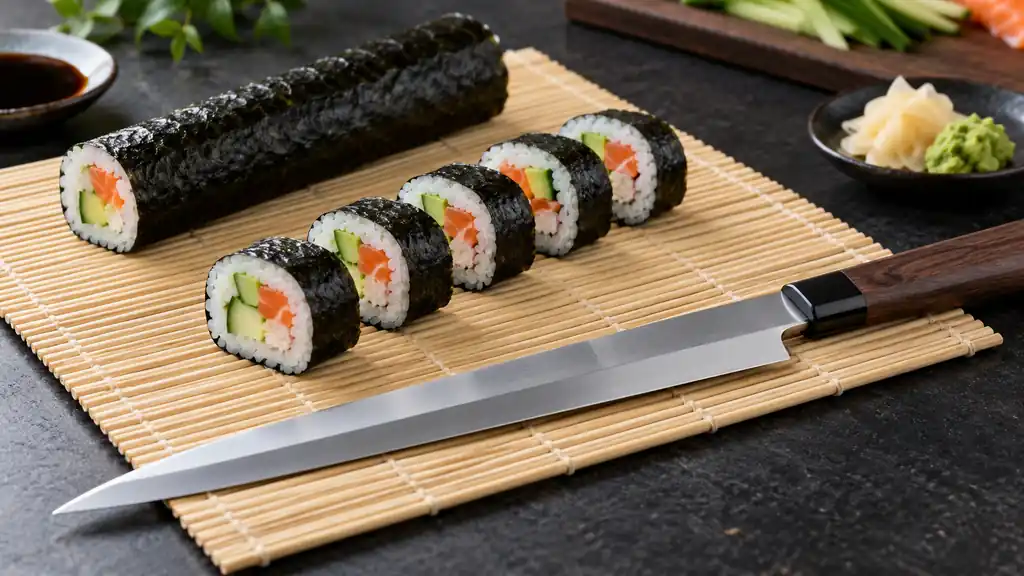
Cutting sushi rolls cleanly is a different job from chopping vegetables or carving a roast. The blade needs to pass through rice, nori, fish, avocado, and fillings without dragging the roll sideways or squeezing its layers into a loose bundle. A long slicing knife can help, yet length alone does not guarantee a tidy cut. Blade profile, edge design, food-release features, handle control, and the way you plan to use the knife all matter.
A common mistake is choosing a traditional sashimi knife for rolled sushi without checking its edge configuration. Several options below use a yanagiba-style, single-bevel design that suits deliberate slicing through fish, while others use double-edged or nonstick blades that are easier for general home cooking and roll portioning. Steel also affects ownership. Some knives list a specific steel and hardness, while others give broader stainless-steel descriptions, so maintenance expectations are not identical. A home sushi maker preparing rolls once a month may value easy cleaning and a protective sheath more than a specialized fish-slicing profile.
This comparison focuses on the supplied knives that directly serve sushi preparation, from traditional Japanese-style sashimi blades to versatile nonstick slicers. The ranking weighs documented blade length, edge design, steel information, handle construction, cleaning needs, and practical suitability for cutting finished rolls. The SHAN ZU 10 Inch Japanese Sushi Knife earns the strongest overall position because its long blade, documented 10Cr15MoV core, layered construction, and octagonal handle create a well-defined option for precise sushi work.
Quick Answer
- Best Overall: SHAN ZU 10 Inch Japanese Sushi Knife. A 10-inch blade, 9-layer construction, stated 10Cr15MoV core, and octagonal red sandalwood handle make it the most complete choice for shoppers seeking a dedicated sushi and sashimi knife.
- Best Traditional Single-Bevel Option: Sumteene Sushi Knife. Its 9.5-inch 440A blade, single-sided edge, slightly curved back, and Pakkawood handle suit controlled fish slicing and traditional yanagiba-style preparation.
- Best Versatile Roll Slicer: Kitchen + Home Non Stick Sushi Knife. Its listed 8-inch blade, nonstick coating, aerated edge, and nonslip ABS handle make it easier to use as an everyday kitchen knife alongside sushi preparation.
Best Knife For Sushi Rolls Comparison Table
| Product | Best For | Blade Length | Edge or Blade Design | Handle |
|---|---|---|---|---|
| SHAN ZU Japanese Sushi Knife | Dedicated sushi preparation | 10 inches | 9-layer blade, 10Cr15MoV core | Octagonal red sandalwood |
| Sumteene Sushi Knife | Traditional fish slicing | 9.5 inches | Single bevel, slightly curved back | Pakkawood |
| HOSHANHO Sushi Knife | Fine sashimi-style cuts | 10 inches | 9-layer blade, 10Cr15CoMoV core | Mahogany with G10 bolsters |
| KEEMAKE Sashimi Knife | Easy-clean fish slicing | 10 inches | 440C steel, nonstick coating | Rosewood with G10 bolster |
| Lucky Cook Sashimi Sushi Knife | Traditional-style home use | 10 inches | Single-bevel design | Pakkawood |
| SANMEIHO Sushi Knife | Fish slicing and general use | 10 inches | 5Cr15MoV, double-sided 12° edge | Red sandalwood |
| Kanngou Sujihiki Knife | Rolls, roasts, and large foods | 27 cm | Double edge, narrow sujihiki profile | Ebony and red sandalwood |
| Kitchen + Home Non Stick Sushi Knife | Everyday kitchen versatility | 8 inches listed | Nonstick, aerated edge with holes | Nonslip ABS |
| Culina Nonstick Sushi Knife | Compact roll cutting and storage | 8 inches | Nonstick coated carbon steel | Ergonomic handle |
The detailed reviews below look at how each blade design translates to real sushi-roll preparation, along with the maintenance and handling trade-offs that may matter in your kitchen.
1. SHAN ZU 10 Inch Japanese Sushi Knife — Best Overall

The SHAN ZU is the most purpose-built choice in this group for someone who wants a dedicated sushi and sashimi knife rather than an ordinary chef’s knife. Its 10-inch blade gives a long, continuous cutting path, which is useful for drawing through a roll in one deliberate motion instead of sawing back and forth. That matters with soft rice and nori, where repeated strokes can tug at fillings and leave ragged ends.
The available specifications identify a 9-layer forged structure, a 10Cr15MoV steel core, stated 62 HRC hardness, and a listed 12-degree blade angle. Those details provide more technical clarity than several competing listings, although a hardness figure alone cannot predict edge life in every kitchen. The octagonal red sandalwood handle gives the knife a traditional Japanese-style shape that may appeal to users who prefer a defined directional grip. It is a specialized blade, so buyers who mostly chop vegetables may find its long slicing profile less flexible than a general-purpose chef’s knife.
Pros
- 10-inch blade provides a long stroke for full-size sushi rolls and sashimi.
- Documented 10Cr15MoV core and 9-layer construction offer clearer material information.
- Octagonal red sandalwood handle supports directional control during slicing.
- Matte blade finish is described as helping reduce fingerprints and food residue.
- Long, narrow format fits dedicated sushi and fish preparation.
Cons
- Long blade may feel cumbersome on a small cutting board or in crowded prep areas.
- Specialized slicing geometry is less convenient for routine rocking or chopping.
This is the strongest fit for a home cook who regularly prepares maki, sashimi, or large fish portions and wants a dedicated tool with a clearly described steel core. The 10-inch length also means storage deserves attention, particularly if your current knife block accepts only shorter blades. Buyers who want one knife for herbs, vegetables, meat, and sushi may prefer a more versatile double-edged design, but for clean, continuous roll slicing, the SHAN ZU offers the most balanced specification set in this roundup.
To buy this product, click here.
2. Sumteene Sushi Knife 9.5-Inch — Best Traditional Single-Bevel Option
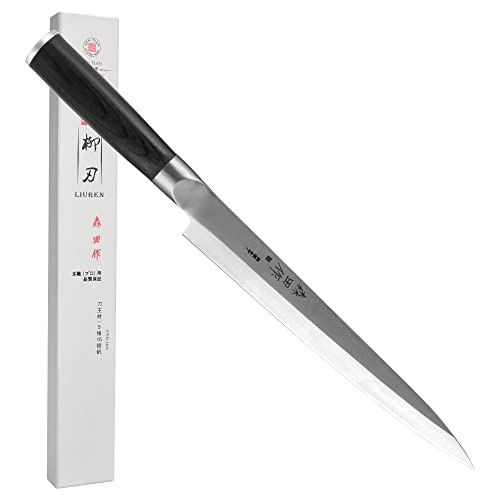
The Sumteene takes a more traditional route with a 9.5-inch yanagiba-style blade, a listed 440A steel construction, and a single-sided cutting edge. Its slightly curved back is described as creating an air pocket that can help keep fish slices from clinging to the blade. For sushi rolls, the same long, narrow format supports a smooth pull through the roll, particularly after the blade has been moistened and the roll has been compressed firmly enough to hold its shape.
The Pakkawood handle is intended to provide a comfortable grip while keeping the knife balanced in the hand. The listing also advises sharpening before use, a useful reminder that a traditional-style blade may require setup rather than being ready for every cutting task immediately. Single-bevel knives demand more attention to technique and sharpening direction than ordinary double-edged kitchen knives. That makes this a compelling choice for a buyer interested in sashimi-style preparation, while a casual sushi maker may find a nonstick double-edged knife less demanding.
Pros
- 9.5-inch length gives enough reach for full rolls and fish portions.
- Single-bevel design follows a traditional yanagiba-style approach.
- Slightly curved back is described as helping reduce fish sticking.
- 440A steel is specifically identified in the product information.
- Pakkawood handle and included presentation box add practical storage and gifting appeal.
Cons
- Listing guidance recommends sharpening before use, adding an initial maintenance step.
- Single-bevel construction may require more specialized sharpening knowledge.
Choose the Sumteene if the tactile and technical character of a traditional sushi knife matters more than all-purpose versatility. It should suit a cook who portions fish and prepares rolls often enough to learn the correct single-bevel technique. Someone who wants a simple knife for occasional California rolls, cooked vegetables, and sandwiches may be better served by the Kitchen + Home or Culina options later in the list.
To buy this product, click here.
3. HOSHANHO 10 Inch Sushi Knife — Best for Fine Sashimi-Style Cuts

HOSHANHO’s knife is aimed at cooks who want a presentation-focused slicing tool. The product information describes a flat, flowing 10-inch blade intended to produce thin, even slices without damaging fish texture. That profile makes sense for long draws through sashimi and completed rolls, where a straight path can leave cleaner faces on each piece than a short blade that requires several sawing motions.
Its 9-layer construction surrounds a listed 10Cr15CoMoV core, with stated vacuum heat treatment, tempering, and 62 HRC hardness. The listing also describes a 12-degree edge on each side, making this specification different from the single-bevel options in the roundup. A natural mahogany octagonal handle is paired with G10 bolsters, which the listing identifies as water-resistant and crack-resistant. The layered and hammered appearance is visually distinctive, though the pattern itself should be treated as a finish and construction detail rather than proof of superior cutting performance.
Pros
- 10-inch flat blade supports long, controlled slicing motions.
- 10Cr15CoMoV core and 9-layer construction are clearly identified.
- Stated 62 HRC hardness and 12-degree-per-side edge provide useful specification detail.
- Octagonal mahogany handle offers a traditional directional grip shape.
- G10 bolsters are listed as water-resistant and crack-resistant.
Cons
- Long specialized blade may be more knife than occasional roll makers need.
- Its stated 12-degree edge on each side may call for sharpening equipment suited to a fine double-edged profile.
The HOSHANHO is a sensible pick for a sushi enthusiast who cares about even fish slices, a refined handle design, and detailed blade construction. It can also work for large rolls that benefit from a full-length stroke. Skip it if your cutting board is narrow or your kitchen routine involves frequent chopping, since the long flat slicing blade is focused on forward cutting rather than broad multipurpose work.
To buy this product, click here.
4. KEEMAKE 10 Inch Sashimi Knife — Best Easy-Clean Dedicated Option

The KEEMAKE combines the long format associated with sashimi knives with features aimed at easier day-to-day care. Its blade is listed as Japanese 440C high-carbon stainless steel with a stated 58 HRC hardness, and the black coating is described as nonstick and hydrophobic. For sushi-roll preparation, a surface that releases rice, fish, and soft fillings more readily can make repeated portioning less messy, especially during a busy family dinner when the knife is being wiped between several rolls.
The rosewood handle transitions into a G10 bolster, while the listing places the balance point near the joint between blade and handle. Those details suggest a knife built around controlled slicing rather than forceful chopping. The coating may simplify cleanup, but it should still be treated as a surface requiring careful hand washing and drying rather than rough handling. A 10-inch blade gives useful reach, though it may feel oversized for small rolls or compact counters.
Pros
- 10-inch length supports continuous slicing through full rolls.
- 440C steel and a stated 58 HRC hardness are documented.
- Nonstick black coating is intended to reduce food adhesion and ease cleaning.
- Rosewood handle and G10 bolster provide a defined transition and substantial grip area.
- Balance point near the blade-handle joint is specified for controlled handling.
Cons
- Coated blade may require more careful care than an uncoated stainless blade.
- 10-inch length can be awkward for small prep spaces and short rolls.
This knife fits buyers who want a dedicated sushi blade but dislike rice and fish residue clinging to polished metal. It is especially appealing for cooks who prepare several batches in one session and value straightforward cleanup. A buyer focused on traditional single-bevel technique may prefer the Sumteene or Lucky Cook instead, while someone who wants a general vegetable and meat knife should look at the nonstick multipurpose model.
To buy this product, click here.
5. Lucky Cook 10-Inch Sashimi Sushi Knife — Best Traditional-Style Home Option

Lucky Cook offers a straightforward traditional-style format: a 10-inch stainless-steel blade, single-bevel design, and Pakkawood handle. For a sushi roll, that length can span the roll in a single pull, helping preserve the round shape instead of compressing the rice with short chopping strokes. The single-bevel layout also aligns with the slicing approach associated with yanagiba-inspired knives.
The listing emphasizes resistance to rust, stains, and corrosion, though it does not provide a specific steel designation. That makes the knife easier to evaluate as a practical stainless option than as a precisely documented metallurgy choice. Its stated uses extend to fish, meat, vegetables, and roasts, yet the single-bevel edge remains a meaningful factor for sharpening and technique. The Pakkawood handle is described as slip-resistant, and the included gift box provides a dedicated storage starting point, but a sheath or knife block may still be useful after opening.
Pros
- 10-inch blade is suited to long slicing strokes through sushi rolls.
- Single-bevel construction follows a traditional sashimi knife format.
- Stainless-steel blade is described as resistant to rust, stains, and corrosion.
- Pakkawood handle is listed as slip-resistant and balanced.
- Gift box provides a practical presentation and storage option.
Cons
- Specific steel grade is not provided in the available product information.
- Single-bevel sharpening is less familiar to many casual home cooks.
Lucky Cook makes sense for a home sushi maker who wants the look and cutting format of a traditional sashimi knife without needing the more elaborate layered construction found higher in the ranking. It should be handled with a deliberate slicing motion and stored securely after use. Buyers who prefer broad technical specifications or a nonstick surface may find the SHAN ZU or KEEMAKE easier to compare.
To buy this product, click here.
6. SANMEIHO 10 Inch Sushi Knife — Best Double-Edged Fish and Roll Slicer

SANMEIHO takes a more accessible approach to sushi preparation with a 10-inch blade made from listed 5Cr15MoV Japanese stainless steel. The product information gives a 57 HRC hardness and a 12-degree cutting angle on both sides. That double-edged arrangement is a useful distinction for home cooks who already sharpen conventional kitchen knives and want a long fish-slicing blade without adapting to a single-bevel edge.
The red sandalwood octagonal handle and full-tang construction are described as providing stability and a secure grip. The knife is also marketed for deboning, fish filleting, steaks, and sushi, giving it broader household potential than a strictly specialized yanagiba. Its stainless construction is presented as easy to clean and maintain, though the blade should still be washed, dried, and stored safely after contact with wet fish or rice. The 10-inch size is helpful for long rolls, yet it can be excessive for small portions.
Pros
- 10-inch blade provides ample length for fish and full sushi rolls.
- 5Cr15MoV steel and stated 57 HRC hardness are documented.
- Double-sided 12-degree edge is familiar to many conventional knife users.
- Octagonal red sandalwood handle and full tang are listed for stability.
- Broader intended use includes fish filleting, steaks, and other slicing tasks.
Cons
- 5Cr15MoV offers less detailed construction information than the layered-core alternatives.
- Long blade may be inconvenient for small boards and compact storage.
This is a practical fit for someone who wants one long knife for sushi, fish, and occasional meat slicing. The double-edged format lowers the learning curve for cooks already accustomed to standard kitchen knives. It is less compelling for a buyer seeking a distinctly traditional single-bevel yanagiba, where the Sumteene or Lucky Cook has a closer match.
To buy this product, click here.
7. Kanngou 27 cm Sujihiki Sushi Knife — Best for Rolls and Large Slicing Tasks

The Kanngou is a sujihiki-style alternative to the single-bevel yanagiba knives in this roundup. Its 27 cm blade is long, narrow, and double-edged, making it suitable for drawing through sushi rolls, fish fillets, roasts, and other large foods. That combination can be useful in a kitchen where sushi is one part of a broader slicing routine. A double edge also gives the knife a more familiar geometry for users who do not want a specialized single-bevel sharpening method.
The blade is listed as AUS-8 alloy steel with a stated HRC 59±2 range. Its Kurouchi Nashiji finish is described as blackened and hammered, and the handle combines ebony with red sandalwood. These features create a distinct visual and material profile, though appearance should not be treated as proof of cutting superiority. The nearly zero-degree micro-concaved edge described in the listing suggests a fine edge concept, so careful use on suitable foods and cutting surfaces remains sensible.
Pros
- 27 cm narrow blade offers long reach for rolls, fish, and roasts.
- Double-edged sujihiki format is more familiar than a single-bevel yanagiba for many users.
- AUS-8 steel and stated HRC 59±2 range are provided.
- Kurouchi Nashiji finish gives the blade a distinctive textured appearance.
- Ebony and red sandalwood handle materials are clearly identified.
Cons
- Long slicing format requires generous board space and careful storage.
- Its broad intended use may appeal less to buyers seeking a purely traditional sushi knife.
Pick the Kanngou if sushi rolls share the cutting board with brisket, roast beef, watermelon, or large fish portions. Its sujihiki profile has a clear practical advantage in those situations because the same long draw-cutting motion carries across several foods. A dedicated sushi traditionalist may still favor a single-bevel blade, while a small-kitchen user may find an 8-inch option easier to maneuver.
To buy this product, click here.
8. Kitchen + Home Non Stick Sushi Knife — Best Versatile Roll Slicer
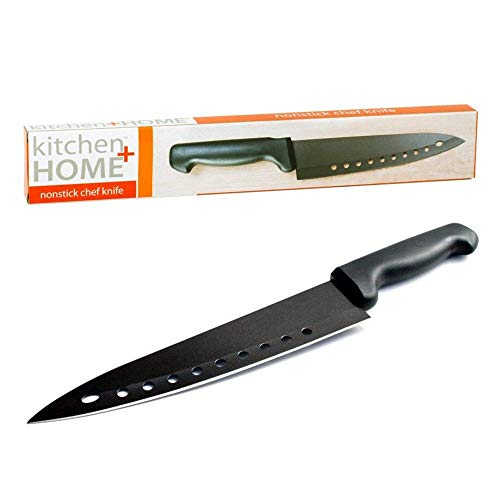
The Kitchen + Home knife is aimed at the buyer who wants to slice sushi rolls but does not want a dedicated sashimi blade taking up space in the drawer. The product title identifies an 8-inch stainless-steel blade, and the listing describes a thin aerated design with ten holes along the cutting edge. Together with the food-grade nonstick coating, those features are intended to reduce sticking as the knife passes through rice, nori, cheese, vegetables, and other moist foods.
Its nonslip ABS handle and lightweight positioning may be useful during a family sushi night, when several rolls need to be portioned and the same knife may later handle vegetables or herbs. The product information also describes a rocker-style profile for mincing and chopping, which separates it from the long, straight slicing blades above. The listing recommends hand washing despite describing the knife as dishwasher-safe, a sensible approach for preserving the coating and keeping the edge in better condition.
Pros
- Listed 8-inch blade is easier to manage than a 10-inch slicer in compact kitchens.
- Nonstick coating and aerated holes are intended to reduce food adhesion.
- Nonslip ABS handle provides a practical everyday grip material.
- Multipurpose design covers sushi, vegetables, meats, fruit, and cheese.
- Rocker-style profile adds chopping and mincing capability.
Cons
- General-purpose profile is less specialized for long sashimi-style strokes.
- Hand washing is recommended despite the listed dishwasher-safe feature.
This is the right direction for a household that makes sushi occasionally and wants a single useful knife for the rest of the week. The coating and shorter blade can help with sticky rolls on a crowded counter, while the rocker profile handles ordinary prep. Buyers pursuing traditional fish slicing, a specific steel designation, or a long one-stroke cut should choose one of the dedicated 9.5- or 10-inch knives instead.
To buy this product, click here.
9. Culina 8-Inch Nonstick Carbon Steel Sushi Knife — Best Compact Design
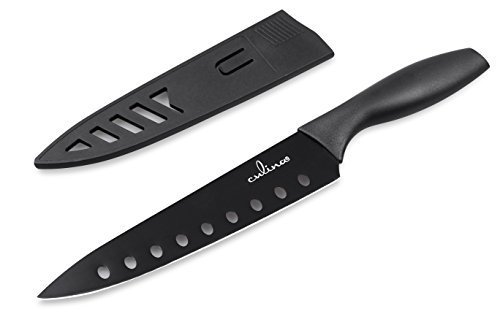
Culina’s 8-inch knife is a compact option for sushi-roll portioning, with a black nonstick finish, a listed carbon-steel construction, and a protective sheath. The shorter blade can be easier to control when preparing small rolls on a narrow board, and the coating is intended to help separate rice, sashimi, vegetables, and other ingredients from the blade. A sheath also gives the knife a safer storage path than leaving an exposed edge loose in a drawer.
The handle is described as ergonomic and balanced, while the blade is listed at 1 3/4 inches wide. This is a different proposition from the long yanagiba-style knives. It is more about convenient home use, quick cleanup, and protected storage than traditional fish-slicing technique. The supplied information calls the blade carbon steel but does not provide a more specific alloy designation, so shoppers should avoid assuming that it has the same maintenance profile as every other carbon-steel knife. Hand washing and thorough drying remain prudent habits for a coated kitchen blade.
Pros
- 8-inch length suits smaller work surfaces and compact rolls.
- Nonstick food-grade coating is intended to aid release during slicing.
- Protective sheath supports safer storage between uses.
- Handle is described as ergonomic, balanced, and firm to grip.
- Versatile blade is intended for fish, meat, vegetables, fruit, and nuts.
Cons
- Shorter blade may require more than one stroke through larger rolls.
- Specific carbon-steel alloy is not provided in the available information.
Culina is a good match for the cook who prepares small batches of sushi and values a sheath more than a formal yanagiba profile. It can sit comfortably in a limited drawer or apartment kitchen, and the nonstick finish addresses one of the everyday annoyances of cutting sticky rice. For large rolls, sashimi boards, or long fish fillets, the 9.5- and 10-inch options will provide a cleaner uninterrupted path.
To buy this product, click here.
Buying Guide
Match the Blade Length to Your Rolls
A knife around 9.5 to 10 inches gives the edge enough reach to cross a full sushi roll in one controlled draw. That approach can reduce the compression that comes from repeated short strokes. The trade-off is counter space. A 10-inch blade needs room to move and a storage method that protects its exposed length. An 8-inch knife is friendlier in a small kitchen, though larger rolls may need repositioning or a second pass.
Decide Between Single-Bevel and Double-Edged Designs
Single-bevel knives such as the Sumteene and Lucky Cook follow a traditional sashimi-oriented format. Their edge geometry can suit deliberate fish slicing, but sharpening requires attention to the bevel and the flat side. Double-edged options such as the SHAN ZU, HOSHANHO, SANMEIHO, and Kanngou are more familiar to many home cooks. They may be easier to integrate into an existing sharpening routine, but the exact edge geometry still matters.
Look at the Blade Profile, Not Only the Sharpness Claim
A long, narrow slicer is built around a draw cut. A shorter multipurpose knife with a rocker profile can handle chopping and mincing as well as roll cutting. Neither profile is universally better. If sushi is an occasional dinner project, the Kitchen + Home model may earn its counter space more easily. If sashimi and fish preparation are regular tasks, a dedicated yanagiba-style or sujihiki-style blade is a more direct match.
Read Steel Information Carefully
The candidates use several documented materials, including 440A, 10Cr15MoV, 10Cr15CoMoV, 440C, 5Cr15MoV, AUS-8, and broader stainless or carbon-steel descriptions. A named steel gives useful context, but it does not establish cutting performance by itself. Hardness figures are available for some models, yet hardness, toughness, corrosion resistance, and sharpening ease are separate characteristics. Wash and dry every knife promptly after working with wet ingredients, especially when the listing does not provide detailed maintenance guidance.
Choose a Handle You Can Direct Precisely
Octagonal wooden handles can help establish a directional grip, which is useful for long slicing motions. Pakkawood, rosewood, mahogany, ebony, G10, and ABS appear across this selection. Material alone does not guarantee comfort for every hand. Pay attention to whether you prefer a defined traditional shape, a nonslip polymer handle, or a bolster transition that gives your fingers a clear stopping point.
Plan Storage Before the Knife Arrives
A long sushi knife should not be left loose in a drawer. The Culina includes a protective sheath, while several other products are supplied in gift boxes rather than purpose-built blade guards. A box can protect the knife during presentation or initial storage, but it may not be the most convenient daily solution. Keep the blade separated from other utensils and verify that any guard or block fits the knife’s length and height.
Use a Suitable Cutting Surface and Cleaning Routine
Prepare sushi on a stable cutting board and avoid hard materials that can damage a fine edge. After slicing, wash the knife according to its care requirements, rinse away rice and fish residue, and dry it before storage. The Kitchen + Home listing mentions dishwasher compatibility but recommends hand washing, while the coated KEEMAKE and Culina models deserve gentle handling to protect their surface finishes.
Best Knife For Sushi Rolls FAQ
What Type of Knife Is Best for Cutting Sushi Rolls?
A long slicing knife is usually the closest match, especially a yanagiba-style or sujihiki-style design. A long blade can cross the roll in one draw, reducing the need for sawing. A nonstick 8-inch kitchen knife can also work well for smaller rolls and occasional home use, particularly if you value versatility over traditional geometry.
A smooth drawing cut and a supported roll help prevent compression. Use the guide to slicing sushi rolls without crushing them alongside the blade dimensions.
Is a Yanagiba Necessary for Homemade Sushi Rolls?
No. A yanagiba-style knife is useful for cooks who prepare sashimi or want a traditional single-bevel slicing tool, but it requires more attention to technique and sharpening. A double-edged slicer or nonstick multipurpose knife may be easier for a beginner who primarily portions maki rolls.
Should a Sushi Knife Be 8 or 10 Inches Long?
An 8-inch knife is easier to maneuver on a small board and works well for short or narrow rolls. A 9.5- or 10-inch blade offers more reach for full-size rolls and fish portions, often allowing one continuous cut. Choose based on your available workspace and the size of the food you prepare most often.
Why Does Rice Stick to a Sushi Knife?
Cooked rice is naturally adhesive, and a dry blade can collect it as the knife moves through a roll. A long slicing stroke, a properly compressed roll, and a clean, lightly moistened blade can help. Nonstick coatings and aerated blade designs are also intended to reduce food adhesion, although they still require appropriate cleaning and care.
Are Single-Bevel Sushi Knives Suitable for Beginners?
They can be, but the user should understand that single-bevel sharpening differs from maintaining a standard double-edged kitchen knife. The Sumteene and Lucky Cook follow this traditional format. Someone who wants a simpler transition from an ordinary chef’s knife may prefer the double-edged SANMEIHO, Kanngou, or HOSHANHO.
Can a Sushi Knife Cut Vegetables and Meat?
Several products are listed for broader slicing tasks, including the SANMEIHO, Kanngou, Kitchen + Home, and Culina knives. A dedicated sashimi-style blade is best reserved for suitable slicing rather than heavy chopping, hard bones, or frozen food. Check the individual product’s intended uses and avoid forcing a thin edge through materials it was not made to handle.
How Should a Sushi Knife Be Stored?
Store it in a sheath, blade guard, suitable block, or another arrangement that keeps the edge separated from hands and other utensils. The Culina includes a protective sheath. Gift boxes supplied with some other knives may help initially, but buyers should check whether the box is practical for daily use and keep the blade dry before storage.
Final Verdict
The SHAN ZU 10 Inch Japanese Sushi Knife is the strongest overall match for Best Knife For Sushi Rolls. Its long blade supports a continuous slicing motion, while the documented 10Cr15MoV core, 9-layer construction, octagonal red sandalwood handle, and listed 62 HRC hardness give shoppers more useful information than broad marketing descriptions alone. It is best suited to a buyer who prepares sushi and sashimi regularly and has enough counter and storage space for a dedicated 10-inch knife.
The Sumteene is the more traditional single-bevel alternative, and the KEEMAKE adds a nonstick surface for buyers who place a higher priority on easy cleanup. For a multipurpose household knife, the Kitchen + Home model is easier to justify because its shorter blade and rocker profile extend beyond sushi preparation. Whichever style you select, match the blade length to your board, respect the difference between single- and double-edged sharpening, wash and dry the knife promptly, and store the exposed edge securely.
