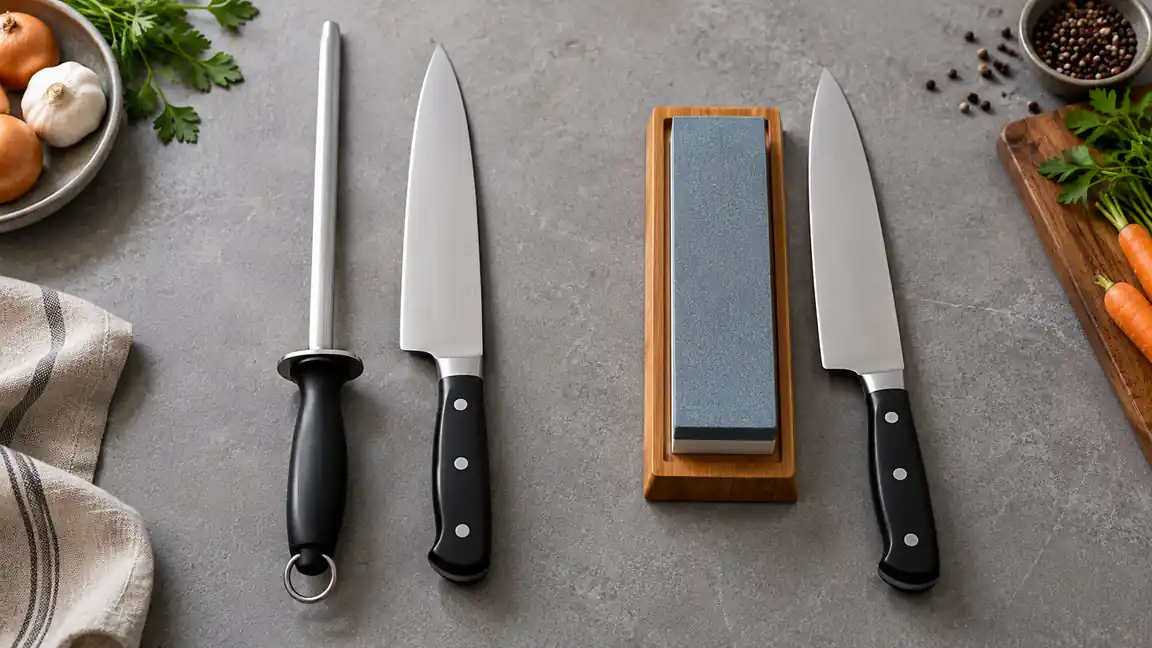
Honing and sharpening are different forms of knife-edge maintenance. Sharpening removes blade material to create or restore the cutting edge. Honing maintains, straightens, or refines an existing edge, although the exact effect depends on the honing tool. A smooth or finely grooved steel is primarily a maintenance tool, while ceramic and diamond-coated rods are abrasive and can remove measurable amounts of metal.
A honing rod can help a knife that has a slightly deformed but otherwise intact edge. It cannot reliably restore an edge that is rounded, heavily worn, chipped, or sharpened at an unsuitable angle. Those conditions require sharpening or repair.
For routine edge maintenance, compare honing rods and their abrasive surfaces only after checking what your knife needs. A smooth steel and an abrasive ceramic or diamond rod do different work, so check the surface as well as the blade’s condition.
Honing vs. Sharpening at a Glance
| Characteristic | Honing | Sharpening |
|---|---|---|
| Primary purpose | Maintain, straighten, or refine an existing edge | Create or restore the cutting edge |
| Metal removal | Minimal with a smooth steel, potentially greater with ceramic or diamond rods | Intentional material removal |
| Typical tools | Smooth steel, grooved steel, ceramic rod, diamond-coated rod, or strop | Whetstone, diamond plate, guided system, pull-through sharpener, or electric sharpener |
| Best used for | An edge that has lost some cutting efficiency but remains properly formed | A rounded, worn, damaged, or incorrectly shaped edge |
| How frequently it is needed | As performance begins to decline, provided the edge responds to honing | When maintenance no longer restores satisfactory cutting performance |
| Effect on blade geometry | Usually limited, though abrasive rods can gradually alter the edge | Can establish a new bevel or change an existing one |
What Honing Actually Does
The cutting edge of a kitchen knife is extremely thin. During ordinary use, the apex can bend, roll, or become microscopically irregular. Honing attempts to improve that existing apex without performing a complete sharpening operation.
Some finishing setups use an abrasive compound, while others are intended for bare leather. Compare stropping compounds only within a compatible process; adding compound is not a universal requirement.
A suitable leather surface can be part of an edge-finishing process. These kitchen-knife strops belong to that refinement stage, rather than a promise to repair every damaged edge.
The familiar explanation that honing simply “realigns” the edge is useful but incomplete. A smooth steel can straighten some deformation and burnish the metal. A grooved steel may have a more aggressive effect. Ceramic and diamond-coated rods contain abrasives, so they remove steel while refining the edge. Pressure, surface texture, blade steel, and the number of passes all influence the result.
Common Honing Tools
- Smooth honing steel: Primarily burnishes and straightens a mildly deformed edge. It removes little material under controlled use.
- Grooved steel: Provides more contact at the raised grooves and may abrade the edge more aggressively than a smooth steel.
- Ceramic rod: Uses a fine abrasive surface to refine the apex. It removes metal and can serve as a light sharpening tool.
- Diamond-coated rod: Cuts more aggressively than a smooth steel. Repeated use can remove substantial material and alter the bevel over time.
- Strop: Refines and deburrs an edge through trailing strokes. Its cutting action varies with the stropping material and any abrasive compound applied to it.
The label on the tool does not fully describe its action. A product sold as a honing rod may function partly as a sharpener if its surface is abrasive.
What Sharpening Does
Sharpening abrades steel from the bevels until they meet at a functional apex. This may involve touching up a moderately dull edge, removing fatigued metal, repairing small chips, or reshaping the bevel.
For compatible ordinary blades, pull-through sharpeners offer a compact guided approach, but fixed slots are not suitable for every grind.
When the edge needs restoration, compare kitchen-knife sharpening systems by compatibility and control rather than assuming a maintenance rod is sufficient.
Sharpening tools vary in speed, control, and compatibility:
- Whetstones provide direct control over angle, pressure, and material removal. Water-stone soaking requirements vary, so the stone manufacturer’s instructions should be followed.
- Diamond plates remove steel with fixed abrasive particles and remain flat during use, although their cutting characteristics vary by construction and grit.
- Guided systems help hold a repeatable angle but still need to match the knife’s edge configuration.
- Manual pull-through sharpeners use fixed slots. Their geometry and abrasives may not suit every blade.
- Electric sharpeners remove metal through powered abrasive stages. Compatibility depends on the supported edge angle, blade type, and manufacturer instructions.
Sharpening commonly produces a burr, which is a thin fold of metal formed as the abrasive reaches the apex. Controlled sharpening includes reducing and removing that burr. Leaving a large burr attached can make a knife feel sharp briefly, followed by rapid performance loss as the weak metal bends or breaks away.
How to Tell Which Process Your Knife Needs
Start with a safe cutting check rather than touching or sliding a finger along the edge. Try the knife on an ingredient it would ordinarily cut, such as a tomato or onion. Use a stable cutting board and a controlled motion.
Try Honing When:
- The knife has recently been sharpened but has begun to lose some cutting efficiency.
- The edge catches or hesitates slightly without feeling completely rounded.
- The blade has no visible chips or significant edge damage.
- The knife has previously responded well to the same honing method.
Sharpen When:
- Honing produces little or no improvement.
- The knife slips on food or needs excessive pressure to begin a cut.
- The edge reflects light along rounded areas when examined carefully under good lighting.
- The bevels no longer meet at a clean apex.
- The edge has small chips that require controlled removal of surrounding metal.
- The knife has been repeatedly maintained with an abrasive rod and the bevel geometry has become uneven.
Large chips, bends, cracks, or substantial profile changes can require professional repair. Aggressive grinding without suitable equipment and experience can overheat the blade, remove excess steel, or create uneven geometry.
If a complete sharpening method is needed, the whetstone-versus-electric comparison explains the control and convenience trade-offs.
How to Hone a Kitchen Knife Safely
These general steps apply to an ordinary double-bevel kitchen knife and a compatible rod. Single-bevel knives, serrated blades, and manufacturer-specific edge designs may require a different method.
- Place the rod securely. Set its tip on a dry, stable cutting board with the handle above it. A vertical position is usually easier to control than sweeping both the knife and rod through the air.
- Choose an appropriate angle. Follow the knife maker’s guidance where available. If the precise factory angle is unknown, match the existing bevel visually rather than imposing an unsupported numerical angle.
- Start at the heel. Place the heel of the edge against the rod with the blade angled away from your hand.
- Use a controlled stroke. Draw the blade down and toward you so the contact travels from heel to tip. Keep the pressure light and the motion deliberate.
- Alternate sides. Repeat on the opposite bevel, using similar pressure and coverage. A few controlled passes are preferable to many forceful strokes.
- Check the result. Clean the blade, then assess it through a safe cutting task. Stop if performance has returned. Continued honing after that point creates unnecessary wear, especially with an abrasive rod.
Keep fingers behind the rod’s guard and outside the blade’s path. Avoid rapid strokes until the movement is controlled, and never attempt to catch a knife that slips.
Why Frequent Honing Cannot Replace Sharpening
Honing can extend the useful interval between sharpening sessions, but it cannot keep an edge functional indefinitely. Cutting gradually rounds and wears the apex. Once sufficient metal has worn away, the bevels must be abraded until they meet again.
An abrasive rod may seem to postpone this point because it removes metal with each use. That still constitutes an abrasive edge-maintenance operation, and repeated strokes can produce a rounded or uneven bevel if the angle changes from pass to pass. A rod also offers less support and angle reference than a flat stone or many guided systems.
Excessive pressure creates further problems. It can roll a thin edge, remove more steel than needed, or cause a hard, delicate edge to chip against an unsuitable rod. Light pressure and a compatible tool are safer than fast, forceful honing.
Knife Design Affects the Right Maintenance Method
Double-Bevel Knives
Most general-purpose kitchen knives have bevels on both sides. They can often be honed by alternating sides, provided the rod suits the blade material and edge geometry. Some double-bevel knives are asymmetrical, so equal treatment on each side may change their intended geometry.
Single-Bevel Knives
Traditional single-bevel knives use specialized geometry that should not be treated like an ordinary symmetrical edge. Sharpening involves the bevel side and the blade’s back according to its construction. Routine alternating passes on a honing rod may damage that geometry. Manufacturer guidance or instruction specific to the knife style is the safer reference.
Hard, Thin Edges
A hard, thin edge may resist rolling but can be vulnerable to chipping from poor technique or unsuitable contact. Some knife manufacturers discourage the use of conventional honing steels on particular blades. Fine stones, compatible ceramic tools, or stropping may be more appropriate, depending on the knife.
Serrated Knives
A standard honing rod does not match the recessed scallops of many serrated edges. Serrations are generally maintained with a tool that fits each gullet, while preserving the original shape and working from the correct side. An incompatible rod can abrade the points without reaching the cutting surfaces that need attention.
Serrations require a separate compatibility check. The guide to maintaining a serrated knife explains why one rod or slot cannot be assumed to suit every tooth pattern.
Sharpening Frequency Depends on Edge Condition
There is no universal schedule for honing or sharpening. A knife used daily on an edge-friendly cutting board will follow a different maintenance cycle from one used occasionally or subjected to hard surfaces. Steel, heat treatment, edge thickness, cutting technique, food type, and storage all influence wear.
Use performance as the guide:
- Hone when a compatible knife shows a modest decline and its edge remains intact.
- Sharpen when honing stops restoring effective cutting.
- Inspect for damage before applying either method.
- Avoid sharpening solely because a calendar interval has passed.
Glass, stone, ceramic plates, and similarly hard cutting surfaces can accelerate edge wear. Loose drawer storage can also damage the edge through contact with other utensils. Appropriate boards and protected storage reduce avoidable maintenance.
Key Distinction
Sharpening deliberately removes material to form a cutting edge. Honing maintains or refines an edge that already exists, but abrasive honing rods also remove metal. The tool’s surface and the condition of the knife matter more than the name printed on the package.
Use a compatible honing method for minor performance loss, then sharpen once the edge is worn, rounded, damaged, or unresponsive. Controlled pressure, attention to the existing bevel, and knife-specific guidance help preserve the blade while avoiding unnecessary steel removal.
