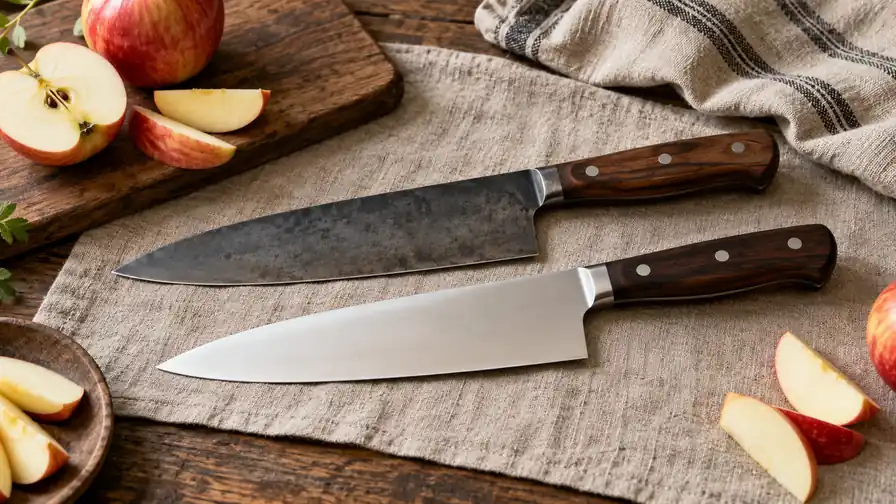
The practical difference between a carbon steel vs stainless steel knife is maintenance. Carbon steel is generally more reactive and can rust quickly if left wet, but many cooks appreciate its sharpening response and the patina it develops. Stainless steel resists corrosion more effectively and usually requires less day-to-day attention. Neither category is inherently sharper, tougher, or better at holding an edge.
Steel composition matters, but so do heat treatment, blade geometry, edge angle, and manufacturing quality. A well-made stainless knife can outperform a poorly made carbon steel knife, and the reverse is equally possible. The better choice depends on how much maintenance you accept and which cutting characteristics matter in your kitchen.
If you are comfortable with prompt drying and more attentive care, compare the carbon-steel chef’s knives before choosing a blade. The maintenance requirements below help explain that trade-off.
Carbon Steel and Stainless Steel at a Glance
| Characteristic | Carbon Steel Knife | Stainless Steel Knife |
|---|---|---|
| Corrosion resistance | Relatively low and sensitive to moisture, salt, and acidic foods | Higher, though staining and rust remain possible |
| Patina | Common during normal use | Generally limited or absent |
| Daily care | Wash and dry promptly during and after food preparation | More forgiving, but still benefits from prompt cleaning and drying |
| Sharpening | Many common carbon steels sharpen readily | Varies widely; highly wear-resistant alloys may take more effort |
| Edge retention | Depends on alloy, heat treatment, geometry, and use | Depends on alloy, heat treatment, geometry, and use |
| Food reactivity | Can react with acidic ingredients and may discolor some foods | Usually much less reactive |
| Appearance over time | Often develops gray, blue, or dark patina | Usually retains a more uniform surface |
| Good fit for | Users who accept attentive care and frequent wiping | Busy kitchens, humid conditions, and low-maintenance routines |
What Carbon Steel Means in a Kitchen Knife
All conventional steel contains carbon, including stainless knife steel. In kitchen-knife terminology, carbon steel usually means a non-stainless steel that lacks enough chromium to provide strong corrosion resistance.
Carbon steel is therefore a broad category rather than one specific material. Different carbon steels can have different amounts of carbon and other alloying elements. They can also receive very different heat treatments. These variables affect hardness, toughness, wear resistance, and sharpening behavior.
A carbon steel blade begins reacting with moisture and food during ordinary use. Acidic ingredients such as citrus, tomatoes, and onions can accelerate discoloration. The blade may develop a stable gray, blue, brown, or nearly black surface called a patina.
Patina Is Different From Active Rust
A patina is a surface reaction that changes the blade’s color. It can reduce further reactivity, but it does not make carbon steel rust-proof. Its color and uniformity depend on the steel, foods being cut, moisture exposure, and cleaning habits.
Active rust calls for a method compatible with the blade and finish. Compare knife rust-removal products only after identifying what needs to be removed.
Active rust often appears orange or reddish and may have a rough or powdery texture. It should be addressed promptly before corrosion progresses into pitting. Deep pits, cracks, or severe thinning are beyond ordinary cosmetic maintenance and may require assessment by a qualified knife repair service.
What Makes a Knife Stainless
Stainless knife steel contains enough chromium to form a thin protective oxide layer at the surface. This passive layer improves corrosion resistance, especially under normal kitchen conditions. The term stainless does not mean stain-proof.
Salt, food acids, prolonged moisture, harsh dishwasher conditions, and damaged surfaces can still cause discoloration or corrosion. Rust can also develop where food residue or water remains trapped against the blade.
Stainless steels differ considerably. Some are relatively simple alloys that sharpen easily and tolerate demanding use. Others contain alloying elements that form hard carbides and increase wear resistance. Powder metallurgy is another production route used for certain steels, but that process alone does not guarantee better knife performance.
High-Carbon Stainless Steel Is Still Stainless
The phrase high-carbon stainless steel often causes confusion. It describes stainless steel with enough carbon to support desired hardness and edge characteristics. It is not the same as a conventional non-stainless carbon steel.
The description is also too broad to predict performance by itself. The actual alloy designation, heat treatment, edge geometry, and construction provide more useful information than a general marketing phrase.
Sharpness and Edge Retention Depend on More Than Steel Type
A carbon steel knife is not automatically sharper than a stainless steel knife. Sharpness describes the condition and geometry of the cutting edge, rather than the blade’s corrosion category. Either material can take a very sharp edge if its composition, heat treatment, geometry, and sharpening support that edge.
Edge retention is similarly complex. It can refer to resistance against several forms of degradation, including wear, rolling, deformation, and chipping. Performance is influenced by:
- The specific steel composition
- Heat treatment and resulting microstructure
- Blade hardness and toughness
- Wear resistance
- Edge thickness and angle
- Sharpening quality and burr removal
- The food and materials being cut
- The cutting board surface
- Cutting technique and lateral stress
Hardness, commonly reported on the Rockwell C scale as HRC, is not a measurement of sharpness. Higher hardness may support a thinner or more stable edge in a suitable steel, but excessive brittleness or unsuitable geometry can lead to chipping. Toughness refers to resistance against fracture, while wear resistance describes resistance to abrasive material loss. These properties should not be treated as interchangeable.
Is Carbon Steel Easier to Sharpen?
Many relatively simple carbon steels have a reputation for sharpening quickly and giving clear feedback on a whetstone. That can make them satisfying to maintain. This remains a general tendency rather than a rule covering every carbon steel knife.
Stainless steels span a much wider range than the label suggests. Some sharpen readily with ordinary abrasives. Highly wear-resistant stainless alloys may require more time or abrasives suited to their carbide structure. A stainless knife with appropriate geometry can still be easier to sharpen than a thick carbon steel knife with a damaged edge.
Sharpen each knife according to its edge construction and manufacturer guidance. A conventional double-bevel knife and a traditional single-bevel knife require different techniques. Fixed-angle sharpeners may also be unsuitable if their preset angle or abrasive stages do not match the blade.
Honing does not replace sharpening in every case. A smooth or lightly textured rod may help maintain certain edges, while ceramic and diamond rods are abrasive and can remove metal. Once the edge is worn or damaged, sharpening is needed to restore its shape.
Carbon Steel Requires More Attention to Moisture
Good care is straightforward, but carbon steel offers little room for neglect. Wipe the blade periodically during extended preparation, especially after cutting acidic or salty ingredients.
Where the maker recommends an oiling routine, choose a product intended for that use. The kitchen-knife oil comparison is separate from deciding whether a particular blade needs oil.
- Wash the knife by hand with mild dish soap and a soft sponge or cloth.
- Keep the edge pointed away from your hand while cleaning the blade.
- Rinse away soap and food residue.
- Dry the blade and handle immediately with a clean towel.
- Store the knife in a dry place where its edge is protected.
Do not leave a knife submerged in a sink, where the edge is hidden and poses a contact hazard. Soaking also exposes the blade and handle to prolonged moisture. Hand washing is the safer care practice for preserving both carbon and stainless kitchen knives, subject to the knife manufacturer’s instructions.
Some carbon steel knives may benefit from a very light coating of food-safe oil before extended storage. The blade must be clean and dry first. Oil does not compensate for moisture or food residue trapped beneath it.
Stainless Steel Is More Forgiving, Not Maintenance-Free
A stainless blade does not normally require wiping after every few cuts, which makes it convenient during lengthy or fast-paced preparation. Prompt washing and drying are still sound practices.
Leaving stainless steel wet overnight, storing it in a damp sheath, or exposing it repeatedly to salty residue can lead to spotting or corrosion. Dishwasher detergents, heat, movement, and contact with other utensils can also damage an edge or surface. Follow the manufacturer’s care directions, but hand washing remains the conservative approach for kitchen knives.
Food Reactivity Can Affect the User Experience
Fresh carbon steel may react strongly with acidic foods. Depending on the steel and ingredient, this can cause dark marks on the blade, discoloration on cut food, or a metallic odor. Reactivity often becomes less noticeable as a stable patina develops, though it does not disappear in every case.
Stainless steel is generally preferable for users who prepare large quantities of citrus, tomatoes, pickled foods, or other acidic ingredients and do not want to pause for frequent wiping. It is also practical in humid environments or shared kitchens where another person may leave the knife wet.
Clad Knives Combine Different Materials
Some kitchen knives use laminated construction with a hard cutting core surrounded by softer outer layers. A knife can have a carbon steel core with stainless cladding. This arrangement reduces the amount of exposed reactive steel while retaining the core steel at the edge.
The exposed carbon steel along the cutting edge can still discolor and rust. Stainless cladding therefore lowers maintenance demands but does not eliminate them. The boundary between the core and cladding is often visible near the edge.
Layered or patterned cladding does not determine sharpness or edge retention. In a clad knife, the core steel, heat treatment, and cutting geometry have the greatest direct influence on edge behavior. Decorative Damascus-style patterning should be evaluated separately from the cutting core.
Which Steel Type Fits Your Kitchen?
Carbon Steel May Suit You If:
- You are comfortable washing and drying the knife immediately.
- You do not mind patina or changing surface color.
- You value the sharpening response associated with many simple carbon steels.
- You control who uses and cleans the knife.
- You are willing to monitor the blade for rust.
Stainless Steel May Suit You If:
- You want greater resistance to moisture and acidic foods.
- The knife will be used by several household members.
- You work in a humid kitchen or frequently prepare reactive ingredients.
- You prefer a blade that retains a more uniform appearance.
- You want a wider margin for delayed cleaning, while still practicing proper care.
Steel should be one part of the decision. Blade shape, cutting geometry, handle comfort, weight, construction, and intended task may have a greater effect on daily use. A thin chef’s knife and a heavy meat cleaver will behave differently regardless of whether both are carbon steel.
Common Misunderstandings About Carbon and Stainless Knives
Carbon Steel Is Not Automatically Harder
Hardness results from the specific alloy and heat treatment. Carbon and stainless knives can each be produced across different hardness ranges. A steel category alone cannot establish an individual knife’s HRC.
Stainless Steel Is Not Automatically Tougher
Toughness varies with composition, heat treatment, hardness, and blade geometry. Some stainless steels are tough, while others prioritize wear resistance. The same variation exists among carbon steels.
Carbon Steel Does Not Always Hold an Edge Longer
Some carbon steels offer excellent edge stability, while certain stainless alloys provide high wear resistance. Cutting conditions and geometry can change practical edge life substantially. Steel names without construction details do not settle the comparison.
A Patina Does Not Mean the Knife Is Dirty
A smooth gray or dark patina can be a normal surface change on carbon steel. Orange rust, rough spots, pitting, and residue are separate issues. The blade should still be washed after food preparation and dried thoroughly.
Frequently Asked Questions
Can Stainless Steel Kitchen Knives Rust?
Yes. Stainless steel is corrosion-resistant rather than corrosion-proof. Moisture, salt, acidic residue, harsh chemicals, and improper storage can contribute to staining or rust.
Does Carbon Steel Affect the Taste of Food?
A new or highly reactive carbon steel blade can sometimes leave a metallic odor or flavor, particularly with acidic ingredients. Keeping the blade clean and allowing a stable patina to form may reduce this effect.
Can You Prevent a Carbon Steel Knife From Developing Patina?
Careful cleaning and immediate drying can slow patina development, but preventing all surface change during regular use may be impractical. Polishing can remove some discoloration, though repeated polishing removes material and is unnecessary for a functional patina.
Is a Carbon Steel Core With Stainless Cladding a Good Compromise?
It can reduce maintenance across most of the blade while preserving the characteristics of the carbon steel core. The exposed core at the cutting edge still requires prompt cleaning and drying.
The Practical Choice
Choose carbon steel if you accept frequent wiping, immediate drying, and natural surface changes in exchange for the characteristics offered by a particular carbon steel knife. Choose stainless steel if corrosion resistance and a forgiving care routine carry greater weight.
Ceramic is a different material choice rather than another type of steel. The ceramic-versus-steel comparison covers its separate handling and maintenance limits.
The label alone cannot predict cutting performance. Compare the specific steel, heat treatment, blade geometry, intended use, and care instructions. Those details provide a more reliable picture than treating either carbon steel or stainless steel as universally superior.
