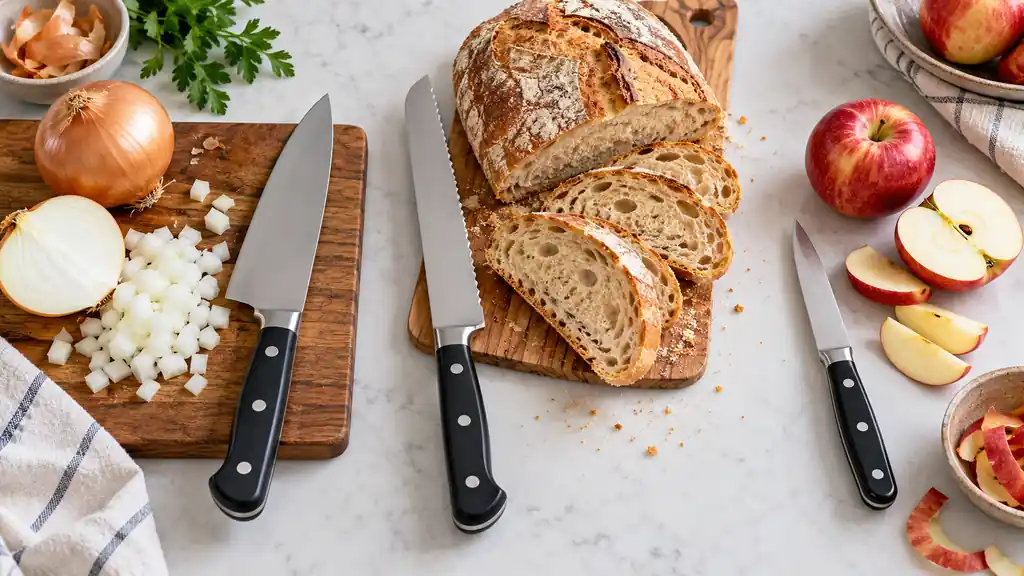
Most home kitchens need three knives: a chef’s knife or santoku for general food preparation, a paring knife for small, precise work, and a serrated bread knife for foods with firm exteriors and soft interiors. This compact selection can handle vegetables, fruit, herbs, boneless meat, bread, and many other everyday ingredients.
Specialized knives become useful when you regularly fillet fish, debone meat, carve roasts, or perform another task that the basic three do poorly. The right collection depends more on what you prepare than on how many knives fit in a block.
Before adding specialist blades, compare everyday chef’s knives by length, handle shape, and the foods you prepare most often. One suitable main knife can cover much of the work described below.
The Three Kitchen Knives That Cover Most Tasks
| Knife | Typical Uses | Main Limitation |
|---|---|---|
| Chef’s knife or santoku | Chopping vegetables, slicing fruit, mincing herbs, and cutting boneless meat | Poor choice for bones, frozen food, and delicate in-hand work |
| Paring knife | Peeling, trimming, coring, and other small precision tasks | Too short for efficient board work on large ingredients |
| Serrated bread knife | Bread, cake, ripe tomatoes, and foods with a tough exterior and soft center | Less precise than a plain edge for general chopping |
A Chef’s Knife or Santoku for General Preparation
The main knife should handle most of your cutting-board work. A Western chef’s knife, gyuto, santoku, or another versatile multipurpose knife can fill this role. You usually need one of these styles rather than all of them.
A chef’s knife commonly has a pointed tip and some curvature along the edge. The curved section supports rocking cuts, while the heel provides clearance for your knuckles. Exact profiles vary, so some chef’s knives are more curved than others.
A santoku commonly has a shorter blade, a less pronounced tip, and a relatively flat edge profile. It often suits chopping and push cutting, though actual cutting behavior depends on the individual blade. A gyuto performs a similar general-purpose role to a Western chef’s knife, but the term does not guarantee a particular weight, steel, thickness, or edge shape.
Choose the style that gives you comfortable board clearance and controlled movement. Blade length, weight, handle shape, and balance can matter more in daily use than the category printed on the packaging.
A Paring Knife for Small Precision Work
A paring knife has a short blade that offers control during detailed tasks. It works well for removing blemishes, trimming strawberries, coring small fruit, peeling produce, and making shallow cuts.
For the small precision role, the paring-knife comparison brings together different lengths and handle layouts.
Some cooks complete these jobs with a small utility knife or Japanese-style petty knife. Those blades may be longer than a typical paring knife and can also handle light board work. If a petty or utility knife already covers your precision tasks comfortably, a separate paring knife may add little value.
Use extra care during work performed while holding food in your hand. Keep the cutting path away from your fingers and body. A cutting board is the safer surface whenever the task permits it.
A Serrated Knife for Bread and Delicate Interiors
A long serrated knife cuts through a firm crust without requiring heavy downward pressure that can crush the soft interior. Bread is its primary job, but it can also handle layer cakes, citrus, and very ripe tomatoes.
Blade length matters here. A serrated blade should be long enough to reach across the loaves or cakes you prepare. Short serrated utility knives can work on rolls and tomatoes, but they may be frustrating on a broad loaf.
Serrated edges remain useful after a plain edge would feel noticeably dull, although they still require maintenance eventually. Sharpening methods vary with serration shape, so a standard flat sharpening procedure may not be appropriate.
Specialized Knives Should Match Recurring Tasks
A specialty knife makes sense when its geometry solves a frequent problem. Occasional tasks can often be handled by the basic three, provided the chosen knife is safe and suitable. Regular butchery, fish preparation, or carving can justify a dedicated blade.
Boning Knife
A boning knife has a narrow blade that helps navigate around joints, connective tissue, and bones. Flexibility differs among models. A stiffer blade can offer control around larger cuts of meat, while a more flexible blade can follow curved surfaces closely.
For recurring fish or meat preparation, the boning-versus-fillet comparison explains the stiffness and profile differences behind those names.
This knife is useful for removing meat from bones and trimming fat or silverskin. It is generally intended to work around bones rather than chop through them.
Fillet Knife
Fillet knives typically have narrow blades with enough flexibility to follow the contours of a fish and separate flesh from skin or bone. Blade length and flexibility should correspond to the type and size of fish being prepared.
Boning and fillet knives overlap, but neither label guarantees one exact design. Someone who prepares fish occasionally may use a suitable boning knife, while frequent fish preparation can make a dedicated fillet knife worthwhile.
Carving or Slicing Knife
A carving or slicing knife has a long, relatively narrow blade for producing clean slices from cooked meat. The added length allows longer strokes, reducing the need for a short sawing motion.
Serving cooked roasts is another distinct task. The slicing-versus-carving comparison explains the overlapping blade shapes.
A sharp chef’s knife can carve an occasional roast or poultry breast. A dedicated slicer becomes more helpful when large roasts, brisket, ham, or poultry appear regularly on the menu. A sujihiki is a Japanese-style slicing knife that can serve a similar purpose, though dimensions and construction differ among models.
Nakiri
A nakiri is a double-bevel vegetable knife with a tall blade and an edge profile that is usually fairly flat. Its shape supports chopping and push cuts, while the blade height provides knuckle clearance and space for transferring chopped ingredients.
If vegetable work justifies a separate broad blade, nakiri and Chinese-cleaver differences help distinguish the options from a bone cleaver.
It can be efficient for frequent vegetable preparation, but it does not replace every function of a pointed general-purpose knife. Its squared profile is less convenient for tip work and some trimming tasks.
Meat Cleaver
A heavy meat cleaver may be appropriate for tasks involving bones, but only where its construction and manufacturer guidance support that use. An ordinary chef’s knife, santoku, nakiri, or thin Chinese vegetable cleaver should not be treated as a bone chopper.
The word cleaver covers distinct designs. Chinese vegetable cleavers often resemble heavy bone cleavers in outline, yet many have comparatively thin cutting geometry intended for vegetables, boneless meat, and general preparation.
Kitchen Shears
Although they are not knives, kitchen shears can complement a small knife collection. They are useful for snipping herbs, cutting parchment, opening food packaging, and handling certain poultry tasks when their construction permits it. Food-use shears should be cleaned according to their materials and manufacturer instructions, particularly around the pivot.
Match Your Knife Collection to the Food You Prepare
- General home cooking: A chef’s knife or santoku, paring knife, and serrated bread knife cover a broad range of preparation.
- Vegetable-heavy cooking: Start with a general-purpose knife. Add a nakiri if its flatter profile suits your preferred cutting motion.
- Frequent bread baking: Prioritize a serrated knife long enough for the loaves you make.
- Fish preparation: Add a fillet knife when breaking down and skinning fish is a regular task.
- Meat trimming and deboning: A boning knife provides better access around joints and curved surfaces.
- Frequent roasts or smoked meats: A long slicing or carving knife can produce cleaner, more consistent slices.
- Small kitchen or limited storage: Keep the basic three and add a specialty blade only after a recurring need becomes clear.
Regular shellfish preparation can justify a purpose-built opener. The oyster-shucking method explains why an ordinary pointed kitchen knife should not fill that role.
Why a Large Knife Set Is Often Unnecessary
A large set may include several blades whose jobs substantially overlap. A chef’s knife, santoku, and utility knife, for example, can all perform some of the same board work. Owning each style is optional rather than a requirement for a capable kitchen.
A defined budget can still favor a small useful selection. These kitchen knife sets under $100 provide a separate comparison of that purchase category.
If a matched collection is useful, compare knife sets by their blade mix rather than assuming more pieces mean more useful coverage.
Count the distinct tasks a set can handle rather than its total number of pieces. Steak knives, shears, and sharpening tools can inflate the piece count without expanding the range of food-preparation knives. A knife block may also leave empty or unused slots while taking up counter space.
A smaller collection has practical advantages. Each knife can be selected for a clear purpose, storage is simpler, and maintenance takes less time. It also becomes easier to notice which blade is dull or damaged.
How to Select Your Main Knife
Choose a Manageable Blade Size
The blade should fit your cutting board, workspace, and preferred range of motion. A longer knife can cut large produce and portions efficiently, but it requires adequate board space. A shorter knife may feel easier to control in a compact kitchen, though it takes more strokes to cut broad ingredients.
Blade fit is a separate question from how many knives to own; chef’s-knife sizing guidance connects length with ingredients and workspace.
Check that the blade height allows your knuckles to clear the board when using your normal grip. A narrow blade paired with a thick handle can cause fingers to strike the cutting surface before the edge completes a cut.
Evaluate Handle Shape and Grip
Handle comfort varies with hand size, grip style, and the knife’s weight distribution. A full tang does not guarantee ideal balance or comfort. Hidden-tang and other handle constructions can also perform well when properly made.
If possible, hold the knife safely and check whether the handle creates pressure points. Confirm that you can control the blade without gripping excessively hard. Left-handed users should also inspect handles with pronounced asymmetrical shaping.
Prioritize Geometry and Edge Condition
Steel matters, but its name does not tell the full story. Cutting performance also depends on blade thickness, grind, edge geometry, heat treatment, and sharpening condition. A well-maintained blade with suitable geometry can be more useful than an expensive knife with a neglected edge.
Carbon steel generally requires closer attention to moisture and can develop a patina. Stainless steel offers greater corrosion resistance, but it is not corrosion-proof. Neither category guarantees a particular degree of sharpness, toughness, or edge retention.
Knives You May Be Able to Skip
A utility knife can be useful between the sizes of a chef’s knife and paring knife, but its role often overlaps with both. A tomato knife adds little if your bread knife is manageable for small produce. A dedicated cheese knife, sandwich knife, or decorative specialty blade may remain unused unless the matching task occurs often.
Before adding a cheese tool, consider how different cheese textures are cut. Some serving tasks can be handled with knives already in the kitchen.
Traditional single-bevel Japanese knives, such as some yanagiba, deba, and usuba, serve specialized techniques. Their geometry, handedness, use, and sharpening differ from ordinary double-bevel kitchen knives. They are not necessary for a basic home collection simply because they are associated with a specific food category.
A Few Well-Maintained Knives Work Better Than Many Dull Ones
Knife selection and knife maintenance are closely connected. A dull edge can slip or require excessive force, while inappropriate storage can damage an otherwise suitable blade.
- Wash knives carefully by hand unless the manufacturer explicitly provides different care instructions.
- Dry blades promptly, especially those made from carbon steel.
- Use a stable cutting board rather than glass, stone, ceramic, or a countertop.
- Store blades in a block, fitted guard, drawer insert, or securely installed magnetic holder that prevents accidental edge contact.
- Sharpen when the edge no longer cuts effectively. Avoid removing more metal than necessary.
- Use honing tools according to their abrasive properties and the knife manufacturer’s guidance. Ceramic and diamond rods can remove material, while other rods may function differently.
- Do not put knives loose in a drawer with utensils.
- Keep ordinary kitchen knives away from frozen food, hard bones, and other materials outside their intended use.
Test cutting performance on food or paper using controlled movements. Never slide a finger along the edge to check sharpness.
How Many Kitchen Knives Do You Really Need?
Three knives are enough for a versatile starting collection: one general-purpose knife, one small precision knife, and one long serrated knife. A household that rarely cuts bread might use the serrated knife infrequently, while an avid baker may consider it indispensable. Someone who buys boneless meat and prepared fish may never need boning or fillet knives.
Add another knife after identifying a repeated limitation. If your chef’s knife is awkward for filleting fish each week, a fillet knife addresses a specific need. If it carves a roast comfortably twice a year, a separate carving knife may offer little practical benefit.
Frequently Asked Questions
Do I Need Both a Chef’s Knife and a Santoku?
Usually, no. Both are multipurpose knives suited to vegetables, fruit, herbs, and boneless proteins. Their profiles and handling differ, but either can serve as the primary knife. Owning both can make sense if different household members prefer different shapes or if each blade has a clearly defined role.
Can I Use One Knife for Everything?
A chef’s knife or santoku can handle much of everyday preparation, but no single blade is ideal for every task. A plain-edged general-purpose knife may crush crusty bread, while a serrated knife is poorly suited to precise chopping. Hard bones and frozen foods also require equipment specifically intended for them.
Is a Utility Knife Necessary?
A utility knife is optional. It can be convenient for sandwiches, small produce, and foods that feel too large for a paring knife but too small for the main knife. Its usefulness depends on whether that middle size fills a genuine gap in your kitchen.
Do Expensive Knives Reduce the Number I Need?
Price does not change the range of blade shapes required for different tasks. One well-made general-purpose knife can cover extensive daily work, but it still does not become a safe bone cleaver or an effective long serrated bread knife. Geometry, suitability, maintenance, and handling matter more than price alone.
Should Every Knife Be From the Same Set?
No. Selecting knives individually allows each blade to match its intended job, preferred handle shape, and suitable dimensions. Matching appearance has little bearing on cutting performance, safety, or comfort.
For a practical starting point, choose a chef’s knife or santoku, a paring knife, and a serrated bread knife. Keep them sharp, clean, dry, and safely stored. Add a boning knife, fillet knife, slicer, nakiri, or cleaver only when your regular cooking creates a clear need for its particular blade geometry.
